Saturday, October 13, 2012

Lincoln (2012)

Though I found myself surprised by how affected I was by "War Horse," Steven Spielberg's last live-action film, it received harsh and, in retrospect, justified criticism for playing like a "Spielberg's greatest hits," a movie packed with everything from meticulously-staged and period-accurate battle scenes to twilight silhouettes of a hero against a bright orange sky, all buried under what could be composer John Williams' most emotionally manipulative and dramatically intrusive score. 

So how does the most commercially successful director in the history of film follow that up? With the stunning "Lincoln," a film that on paper would seem like another in a line of obvious Spielberg choices but one that surprises in almost every aspect imaginable. In fact, just about anything you can think of as a classic Spielbergian film maneuver is approached in a fresh and arresting way. It is a talky film from a master of action. A war film that shows little war. A panoramic story that zooms in to such a small amount of time that it is unexpected and even shocking.

Aided by thorough research, fresh approaches to directorial choices and transcendent performances, "Lincoln" belongs in the Spielberg firmament and is easily his best work since "Munich."

I decided not to read much about "Lincoln" before attending an advance screening of the film, so I suspect that one of the things that surprised me most about it won't be a surprise to most audiences once the film is released, particularly not if you are about to read the next few sentences. But I entered the film not knowing specifically what Spielberg's scope would be in terms of storytelling. I figured the movie would only cover his presidency and nothing of his life before that time. I was wrong. It's even more narrow than that.

In what I now consider a stroke of genius, Spielberg zooms in on only one month of Lincoln's presidency - January, 1865 - for two hours of the film's 2:25 running time, its final 20 minutes covering Feb. 1 through to his assassination on April 15. In doing so, "Lincoln" essentially covers only one issue of the Lincoln presidency: the fight to pass the 13th Amendment guaranteeing the freedom of all slaves.

The film's plot reveals a genuine Catch 22 before that phrase existed. Should Lincoln follow through with a potential peace deal with the Confederacy before the amendment to the Constitution goes to a vote, or should the amendment get passed before an end to the war is brokered, even if it means a high number of additional casualties? Does success in one of these endeavors kill prospects in the other if they are executed in the wrong order? In "Lincoln," we watch the president work through this problem, and Spielberg uses Lincoln's decision-making process on this one issue as a microcosm for his entire presidency and, in fact, his very character.

The film's script, filled with elaborately-crafted orations by Pulitzer Prize-winning playwright Tony Kushner, maneuvers between three ongoing snapshots of our 16th president: Lincoln's personal decision making and power brokering, the debate in the House of Representatives over the proposed amendment, and Lincoln's personal relationships with his family.

The scenes in the House chambers, while certainly lacking in physical action, are quite possibly the film's most entertaining moments, and often the most explosive.This has a lot to do with the fiery spirit of abolitionist Thaddeus Stevens, played with such conviction and ferocity by Tommy Lee Jones that he nearly steals the picture from a mind-blowing performance (but one that is muted by comparison) by Daniel Day-Lewis as the president. Jones has such a way with Kushner's sometimes verbose theatricality that you start to miss him when he's off-screen.

In the House chambers, Stevens squares off against Fernando Wood (Lee Pace) and those who are trying to kill the 13th Amendment in the House (which had already passed in the Senate). Meanwhile, Lincoln is shown working with members of his cabinet to devise a plan to win over enough votes. His chief confidante and critic is Secretary of State William Seward (David Strathairn), and he balances Seward's concerns with a request by Francis Preston Blair (Hal Holbrook), a former cabinet member for Andrew Jackson and father of one of Lincoln's cabinet members with a strong opinion about how to end the war.

Some of the film's most powerful scenes are the ones that happen away from its political war games, and they are both economical and effective in helping viewers to understand more about Lincoln, the man. Sally Field plays First Lady Mary Todd Lincoln in that slightly over-the-top Sally Field kind of way, but it works here (it really, really works!) because Mary famously ends up going mad and Field lays that groundwork nicely, referencing the early death of one of their boys. Their oldest, Robert (Joseph Gordon-Levitt in a stoic but relatively thankless role), wants to enlist but his parents cannot bear the thought of losing another son. And some of the film's most touching moments involve quiet exchanges between Lincoln and his youngest, Tad (Gulliver McGrath). I was particularly reminded of the baptism scene in "The Godfather" as Lincoln is seen reading a book with Tad in the White House while the fateful vote is being taken at the Capitol building.


Both Stevens and Lincoln are seen in candid moments where they appear to be compromising their beliefs and values, though these apparent lapses in judgment are truthfully no more than political moves that seem to be necessary to achieve a much larger, noble goal. Lincoln, for example, is a man of the highest moral character in the minds of most of us students of American history, but in "Lincoln" we find him assembling a team of fly-by-night and relatively reckless lobbyists (played with zeal by John Hawkes, Tim Blake Nelson, and a seemingly "True Grit"-inspired turn by James Spader) who are charged with securing the last remaining votes necessary to pass the Amendment, and appear to do so by any means necessary with Lincoln's turn-a-blind-eye permission. Stevens, meanwhile, finds himself needing to strategize his use of words at the potential expense of both his beliefs and his image to achieve a greater good.

Indeed, if "Lincoln" could be boiled down to one word, that word would be "compromise." In a post-screening interview, Spielberg told the audience that he did not intend to make "Lincoln" as a statement on our government's current inability to work across the aisle together, adding that the first draft of this script began in 1999 after he met "Team of Rivals" author Doris Kearns Goodwin and expressed interest in the movie rights to her book. But it's hard to watch "Lincoln" and not see the writing on these otherwise dark walls. Hey, boys and girls, let me tell you a story of a time when men who disagreed figured out how to compromise because it was imperative that they did so. In that sense, "Lincoln" is dripping with irony and in-this-moment relevance and almost makes you more angry about what we're dealing with now.


Spielberg called "Lincoln" his "most performance-based movie ever," and I had to think about that for a minute because I can't think of a film of his without wonderful performances in it. But the success of "Lincoln" lies solely with its actors because with the exception of the film's opening battle sequence, the movie lacks the element of movement that is traditional in mainstream film narrative, and that which is certainly standard in Spielberg films. There is no question that audiences who don't enjoy listening to speeches and relishing acting performances will think less of this movie that I did, but if acting's your thing, I challenge you to find a performance of any consequence to the plot of this film that isn't worthy of an Oscar nomination.

Naturally, the greatest performance of them all is courtesy of Day-Lewis as the president. Of course, it's hard to think of a bad Daniel Day-Lewis performance, but wait until you see this. He is President Lincoln. The transformation is unbelievable, and the names of Spielberg's makeup team might as well be engraved on an Oscar statue right now. But Day-Lewis's physical transformation is as much under his own power as it is the technical team's. He captures Lincoln's poor posture, arms too long and heavy for his frame, and shuffle of a walk. And though the voice he chose is drawing some criticism, I thought it felt right. Based on their research, Spielberg and Day-Lewis choose to avoid what Spielberg refers to as the "Epcot version" of Lincoln, opting instead for a reedy and higher-pitched mid-western tenor. Though we've never heard a recording of Abe's voice, this acting choice simply works.

As I've mentioned a few times, one of the reasons why I am so moved and blown away by "Lincoln" is because here is the work of a director with 26 previous feature-length films to his credit who has a true auteur's style of approaching his craft, and in my mind, if he doesn't abandon it here, he largely dismisses it. He not only preferences talk over action and lasers in on a narrow narrative scope when grand storytelling is his typical approach, but he uses other members of his famous creative team in fresh and effective ways.

Most noticeable to me was the restraint of John Williams' music. It's as if Spielberg is reacting directly here to the criticism surrounding "War Horse," because Williams' work here often lays quite low in the sound mix and is frequently reduced to simple piano work, returning the score to supporting status when perhaps it last had a leading role. It is understated and wholly effective.

So, too, is the dark palate of mastermind cinematographer, the great Janusz Kaminski, who lends to the film's meticulous period authenticity with oil lamp and candle-lit interiors, emphasizing drab blues and browns. Combined with Spielberg's surprisingly claustrophobic and frequently tight shot framing, Kaminski rarely allows the audience a panoramic view of any interior room of the White House. Instead, even as light pours outside its windows, Lincoln is seen huddling over a dim light source in darkened interiors in his attempts to read. Both Spielberg and Kaminski dramatically reduce the grandeur of Washington's most famous buildings, and in doing so intimately put the focus on the men inhabiting them. It is a brilliant move, because only Lincoln himself emerges with that level of grandeur because of it.

I could go on at length about the various decisions Spielberg made, dissecting them and comparing and contrasting them to his earlier works. But I've already gone on too long and said too much, though I promise that I cannot ruin the viewing experience for you, as this is a movie you truly must see for yourself. As a matter of fact, I'm looking forward to watching "Lincoln" again when it hits theatres to see if Spielberg made any last-minute alterations to the cut I saw. I also want to more deeply focus on the film's subtleties, such as the way he uses the black actors in the film, relegated to the wings but constantly a presence, gentle reminders to Lincoln of what he is fighting for.

If "Lincoln" has an agenda, it is one that most audiences will agree with. But Spielberg avoids the sentimentality typically associated with his films and, in his expert hands, navigates the story's inevitable conclusion in an appropriate manner.

I have spent days now thinking about how "Lincoln" appears on the surface to be a classic Spielberg project. It's one of his "histories." (Like Shakespeare, Spielberg works can be divided into categories, sharing histories and adding action/thrillers and science fiction/fantasy as his other major genres.) It is as well-researched and authentic as any historical film he's ever made, down to the details of portraying the president as a perpetual storyteller, sometimes even attempting a laugh or garnering the impatience of his audience. But in so many more ways, I'm constantly reminded of how "Lincoln" is different from a typical Spielberg film. And for a director more than 40 years in to film making, my stove pipe hat is off to him.


★ ★ ★ ★

Friday, October 12, 2012

Hotel Transylvania (2012)

Almost without exception, I would consider Adam Sandler to be the life force that can suck the joy and competence out of any film he touches, a sad reality when you consider how genuinely funny he could be in his sketch comedy days on "Saturday Night Live." But I never thought that would extend to movies that just contain Sandler's voice.

Alas, his voice and his behind-the-scenes work as producer are enough to throw the animated "Hotel Transylvania" directly into the cinematic circular file. Co-written by "SNL" collaborator Robert Smigel and directed by TV animation veteran Genndy Tartakovsy, "Hotel Transylvania" takes a fairly clever idea and a far better than average vocal cast and generates 90 minutes of spastic movement swirling around recycled ideas.

To put it another way, I found the film so unmemorable that I struggle now to recap it for you. But I'll take a shot at it...

Dracula (Sandler) is left to raise his daughter Mavis (Selena Gomez, a Disney star swap-out for the originally cast Miley Cryus) alone after the death of his wife at the hands of humans. Vowing to protect Mavis, he has a giant castle of a hotel built in Transylvania where monsters and creatures of every type and variety will be welcomed in their travels and feel safe from human interaction and danger.

Mavis, in a storyline highly derivative of everything from Rapunzel to this summer's "Brave," wishes to see some of the world and whenever her birthday comes around, her hopes are repeatedly crushed by her father. That is until her 118th birthday, when Dracula relents. But unbeknownst to Mavis, her first experience in the human world is nothing more than a hoax, elaborately staged by her father with the help of local zombies (playing humans, naturally) to guarantee that she will no longer desire to leave the hotel.

This plan seems to work until the inevitable human infiltrates the many barriers set up to keep him away from the castle. Dracula is immediately aware that the jam band-loving, slacker-y Jonathan (Andy Samberg) is in fact a human, and explodes into panic as he attempts to remove Jonathan from the hotel, or at least disguise him from the other monsters. But in a plot twist I doubt anyone wouldn't see coming, Jonathan bumps into Mavis and the two are, like, waaay into each other, man.

Thus a father must come to terms with his daughter loving a being of another species and his Marlon-in-"Finding Nemo"-like obsessiveness with controlling his child's every move. And one human is able to cause the slightest nudge in the monsters' perception of humans as creature-killer-terrorists.

The fact that "Hotel Transylvania" is little more than a half dozen preexisting animated film story plots (all originally told better) dressed up in Halloween costumes is simply unavoidable. While it certainly matters little to kids, there is not a single new idea or message in this film once you get beyond its morose and actually quite dramatic and interesting premise. Indeed, the film's few decent moments are explorations of Dracula's great loss and fears of suffering further loss. And a touching late-act scene in which Dracula and a few of his comrades realize just how accepted they can be in the human world has real-world resonance that is highly current. Sadly, these moments of promise are as fleeting as a ghost through one of the hotel's hallways.

Classic Universal horror film characters such as the Frankenstein monster, Mummy and Werewolf appear here in mutated forms in supporting roles energetically voiced by Kevin James, CeeLo Green and Steve Buscemi respectively, and they keep kids entertained with their antics. Joining them are a host of "SNL" alums from Jon Lovitz to Molly Shannon. But with nothing fresh to work with in terms of material, there is little pleasure in hearing what their voices can do.

In addition, the animation itself is lackluster. Earlier this year, I strongly disliked the big screen version of "Dr. Seuss' The Lorax," but at least while doing so, I was delighted by the vivid colors and wonderful animation. "Hotel Transylvania" was unable to satisfy me even on this level. For a film so long in development, how could Sony's animation division put out something so uninspired, so visibly rudimentary and rushed?

My kids really enjoyed "Hotel Transylvania," and I bear no ill will toward anyone of their age who has a blast watching a monster movie in such a unique position to take the abject terror out of some of film's most notoriously scary monsters; even the child of weakest wills can laugh free of fear in this picture. But no one over elementary school age has any excuse to enjoy "Hotel Transylvania." That is, unless they've never seen another animated film before.

Ultimately, I did find myself in alignment with "Hotel Transylvania" on one issue, a thought that came to me about a third of the way in and never left me. Just like any human trapped in a monster hotel would say, I found myself whispering: "Get me out of here!"

0.5 out of 4


Saturday, August 18, 2012

The Campaign (2012)

For the first time in my life, I drove to a movie theatre and laid down money to see a film starring Will Ferrell. Having been a huge fan of his work on "Saturday Night Live," it's been my disappointed belief ever since that Ferrell's genius is limited to bursts of no more than 10 minutes, some sort of Faustian bargain to make him the funniest guy on the planet in exchange for the brevity of wit that would forever curse him to never carry a film.

Believe me, I tried to laugh at Farrell's movies, though I never trusted him - or them - enough to see them in the theatres. I decided that when Farrell is not the focus, such as in "Old School," his film work seems to stand up better. And as a news and media guy, I've wondered again and again why the beloved "Anchorman" is so not funny to me.

So I don't know what possessed me to want to take a chance on "The Campaign," but I did. And either I was exhausted when I saw it or just genuinely open to it, because I really enjoyed it. Like a lot. Like more than I'd like to admit. Co-starring the also funny-quirky Zach Galifianakis,"The Campaign" is a sly satire on the absurdity of the political campaign season in America.

Ferrell plays congressman Cam Brady, a smug political asshole preparing to run unopposed for reelection to his North Carolina seat, who is shockingly and suddenly challenged for it by a pouf of a man named Marty Huggins, a doughy, unimposing family man who's backed by a super pac with dubious capitalist and corporate interests to take the seat. Huggins, of course, is genuinely interested in helping his community and is unaware of the source of his growing power to challenge Brady.

The campaign season becomes a game of one absurd one-upsmanship, with Brady subjecting Huggins to sleazy acts of embarrassment and Huggins learning to dig back thanks to the the arrival of Dylan McDermott as a macho mercenary of a campaign manager, who begins his work by first replacing everything in Huggins' home to improve his image, even going so far as to exchange the two family pugs for golden labs, which test market better with voters.

The personal attacks on each other go to such great and childish lengths that I wouldn't dare spoil them for you by listing them here, because the fun of watching "The Campaign" is knowing that each act of retaliation will only be more ridiculous than the last and waiting to see what specifically we will get.

The film has a supporting cast that isn't being advertised enough in the shadow of its two huge lead stars, but support work by McDermott, Jason Sudeikis (as Brady's campaign manager),and Dan Ackroyd and John Lithgow (as scheming and dubious revenue sources to the Huggins campaign) are just additional reasons why this particular film holds up a little better than Ferrell movies in the past.

I've read more negative reviews of "The Campaign" than positive, and what I've found interesting is that most of the negative reviews express disappointment over the fact that the film had the opportunity to be a sharp satire on American politics but wasn't. They propose that to see it as such is to be creating subtext that director Jay Roach never truly put there. What movie were they watching?

Take it from me: that satire is there, and perhaps the reason I liked "The Campaign" is because it's one of the only times I can think of when Ferrell's on-screen insanity has been grounded by something truly topical. His eccentric characters are always to be laughed at because they are so out there. But you can't watch this film without nodding your head with the familiarity that Cam Bradys exist right now, everywhere, all over America. They are perfectly-coiffed, handsome, hollow shells of men being filled by ideas by those who put up the dollars to fund their campaigns. And only the insane level of farce that this film goes to can achieve a sense of comedy when, in reality, lesser versions of the same games are actually being played out there, and they are not funny at all.

Entertainment Weekly critic Owen Gleiberman is wise to point out, I think, that director Jay Roach is not one of Ferrel's traditional collaborators and that Roach has previously directed the political HBO films "Recount" and "Game Change." So although this is also the man who brought us Austin Powers, he knows what he's doing when it comes to exploring the American political landscape in terms of the aspects of it that make us scratch our heads.

By the time "The Campaign" is over, we reinforce the idea that some of our elections are choices between bad and worse, and Roach ultimately calls voters on the carpet, too, for the decisions they ultimately make. And for me, the stroke of genius to lay a foundation of truly relevant and grounded social satire underneath Ferrell's largely unaltered buffoonery was enough to make me say that I paid for a Ferrell movie...and I liked it!

3.0 out of 4

Friday, August 3, 2012

Ted (2012)

Since my formative years occurred during the 1980s, I've got some fairly romanticized memories of that decade. The older I get, in fact, the more I think the 80s was the greatest decade, like ever. This, of course, cannot possibly be true, but it's my reality. Nor could it be true that that a slightly-altered version of one of that decade's greatest toys, Teddy Ruxpin, could carry a modern-era, feature-length film. Here, I'm more realistic; it can't. Not even in the hands of the one guy who could actually pull it off, fellow 80s-lover, Seth MacFarlane. His teddy-bear-comes-to-life tale, "Ted," is a great idea with some outrageously funny moments, but it's difficult not to watch and wonder why the film wasn't more clever still. "Ted" is all empty calories: you laugh and laugh and then in between jokes wonder why the movie is so lame.

The big let-down in "Ted" is not the humor, which is as outrageously politically incorrect as one would expect from the creator of "Family Guy." Instead, it's the plot, which is so pedestrian that any remotely alert viewer who has ever seen anything will figure it out rather quickly and be completely accurate with the prediction. "Ted" tells the story of a loner boy named John who receives a huge teddy bear for Christmas one year as a boy and makes a wish that the bear, which he names Ted (of course), will be his friend forever. The bear comes to life to accept this agreement.

The one funny plot hook of the film - its one clever conceit - is the exploration of what would happen later in life when that boy is now a man. What happens to the bear? "Ted" flashes forward to show us a now 35-year-old John (Mark Wahlberg), who is barely what you could call a man, but still doing almost everything with Ted (voiced by MacFarlane in a vocal performance sometimes too similar to his Peter Griffin). After all, how do you just box up, donate, or otherwise get rid of a teddy bear who's come to life?

And why would you want to? Ted is a hard-core party animal: a sex-crazed, beer-guzzling bear who scores the best pot in the neighborhood, makes jokes about 9/11, and calls fat kids "Susan Boyle." He's always been the life of John's party, and John's party has always revolved around Ted. So when John, the biggest film case of arrested development I've seen in years (and there are tons of films with these kinds of characters around right now) tries to navigate his romance with Lori (Mila Kunis) with Ted looking on, well, it's clear that the film is headed for a very stereotypical "it's either me or him" ultimatum on the part of the girl who has waited four years for a marriage proposal, and for her man to grow up. I can stop summarizing the plot here, because you already know that John will make her promises and that Ted will interfere and screw them up. John will be forced to choose between the two and will choose the girl, and then a dejected best friend will cut off communication with him for a while but ultimately the friends will be reunited by some sort of conflict that will end with the three of them happily, if inexplicably, accepting each other.

Couldn't the brilliant writer of "Family Guy" come up with something better than this? Film critic Brad Brevet, who disliked "Ted" much more than I did, makes a fantastic point when he reminds us that MacFarlane, on his TV show, "has a knack for pointing out the weaknesses in films and television shows and yet when it comes to creating a film of his very own he decides on the most cliched storytelling available to him." I couldn't summarize the problem with "Ted" better, so I won't try to. The film feels like a cheap excuse to string some jokes together, a scenario rather than a plot. And that's a big disappointment.

What I found far less disappointing, however, was the humor in "Ted," unapologetic in its pervasive use of crude, offensive and culture-skewering humor. Maybe it's because I am only three months older than MacFarlane that I share much of his sense of sarcasm and taste for what's funny. So a scene featuring actor Giovanni Ribisi dancing in front of a TV to a Tiffany music video, for instance, is as funny to me as it is to him. And MacFarlane's rapid-fire use of pop culture references, some of which might be obscure to teenaged fans of "Family Guy," are firmly within my wheelhouse and memory bank of childhood, meaning that they strike me right at the funny bone in an instant, with no need for further context clues.

The dialogue exchanges between John and Ted give the film its best moments. In one particularly funny conversation, Ted tells John that he's met a girl with a "white trash name" and they turn it into a game, John running through over two dozen names without taking a breath. What's even funnier is that most of the names are relatively common, thus meaning that MacFarlane is calling many of "Ted"'s female audience members "white trash" by proxy. Not that much of "Ted"'s audience is female; "Ted" joins "The Dark Knight Rises" as an oasis for movie-going men in the summer of "Magic Mike."

I laughed so hard at "Ted" that I think I'd eventually need to see it again to get some of the jokes I missed. In fact, while reviewing some of the great quotes from the film on IMDB, I saw at least three that I didn't even remember. No doubt I was in the middle of punching my best friend's arm in the movie theatre or stabilizing my rolling office chair in the upscale eatery-theatre to prevent my friend from shoving me down the aisle flight of stairs in a fit of laughter. Ultimately, "Ted" is not only about a man who won't grow up enough to not need his teddy bear, but a man who won't grow up enough to work his way beyond ironic, childhood pop culture humor. And while I can't relate to the film's pervasive use of drug humor, I can certainly relate to that.

2.5 out of 4


Sunday, July 29, 2012

The Dark Knight Rises (2012)

In an attempt to balance the dual forces of comic book geek and film buff fighting within me, I feel like I was one of the only people who gave 2008's "The Dark Knight" less than a four-star review. Yes, Heath Ledger was transcendent as The Joker - deserving of that Oscar no matter what the back story of his death added to it - and yes, the film deserved the Best Picture Oscar nomination it never got.

But no, it wasn't the be-all-and-end-all movie that everyone said it was. It was too long. It did not end well. The Harvey Dent storyline needed tweaking. The film's message was too heavy-handed and hammered home. It was an excellent film, but not one for the ages.

So now that I've seen the final film in Christopher Nolan's Batman trilogy, "The Dark Knight Rises," I'm laughing to myself that once again, I'm at odds with most of the other critics on this one. Most every review I've seen has said that this film doesn't measure up to "The Dark Knight." And I guess I agree with that. Because I think it surpasses it. THIS is the four-star Batman movie, and it's not even close. And I'll tell you why.

Now before I get too far into it, I'll address what might be perceived on the part of some readers as a flaw in my logic: the running time issue. Because yes, "The Dark Knight" rises comes close to being a half-hour longer than "The Dark Knight," and just barely in the double-digits away from the dreaded three-hour mark, which is about all I can take from a movie, and I said that "The Dark Knight" was too long. But I felt that way because that film did not end in the right place. It had a logical ending, I thought, and then tacked on more. I dare anyone to try and convince me that the final half hour of "The Dark Knight Rises" made the film feel a half-hour too long. In fact, it's probably most viewers' favorite part. They might say instead that it's the opening half-hour that deserves chopping. I happen to disagree with that too. But suffice it to say, this film was deliberately and carefully timed, and as long as it needed to be.

It's tradition to include a plot summary in a film review, but I don't want to give away much. Let me just remind you of a few basics needed going into this film, whether or not you've seen either of its predecessors or have read any Batman comics. It's eight years after the conclusion of "The Dark Knight," and Bruce Wayne (Christian Bale) is in a Howard Hughes-like seclusion in a section of Wayne Manor mostly covered in sheets, as if he's not only recovering from his days as Batman but somehow ashamed of his real identity as a Wayne. Batman, in a deal brokered with Commissioner Gordon (Gary Oldman) took the fall for Harvey Dent, the spirit of reform in Gotham City who was, in truth, its newest villain Two-Face, because both men agreed that the people needed to maintain his image of martyred idealism to keep hope alive in their fragile city.

A legal mandate bearing Dent's name has put hundreds of criminals behind bars, but not Bane (Tom Hardy), a menacing, hulkish vigilante who wears a face mask that provides him with chemical relief from otherwise unbearable amounts of pain he's endured in his past. Bane, it turns out, is, like Wayne, a former trainee of Ra's Al Ghul, but one who aims to bring the plan of the League of Shadows to fruition. The plan, of course, involves the complete destruction of Gotham City.

Wayne is ultimately convinced to re-don the cowl thanks to gentle nudges from both the Commissioner and one of his officers, the young and idealistic John Blake, with a connection to Bruce that's too good to spoil. And perhaps Bruce receives additional encouragement to reappear as Batman thanks to the arrival of Selina Kyle (Anne Hathaway), a sexy and seriously accomplished cat burglar/jewelry thief (known in Batman folklore - but never expressly here - as Catwoman).

The decision to reappear as Batman is gently but firmly protested by Bruce's faithful butler Alfred, and Michael Caine's performance as the wise servant is the acting highlight of this film and the element that gives "The Dark Knight Rises" the kind of pure emotional core than neither of the previous installments could claim. I dare say that Caine's work here is every bit as good in its own way as was Ledger's in the last film, but because Caine already has Oscar bookends at home and is still alive, he probably won't receive proper recognition for it.

Neither will Hathaway, who surprises with the best film version of Catwoman ever, with apologies to Michelle Pfeiffer, who had me at attention as a young man with her take on the role in Tim Burton's "Batman Returns." Hathaway is not only all confidence and curvy swagger, but her very movements are borderline-erotic and her quips account for the majority of the light moments in an admittedly dark, heavy, and humorless film. She was shockingly good, exceeding all of my expectations for that character.

Critics are already saying that Hardy's Bane lacks the charisma of previous Batman villains. I find this fight to be unfair, as everyone knows that The Joker is the greatest of all of the Batman villains and only those who followed the comic into the 1990s and beyond will even be aware of who Bane is. Those readers will also be disappointed in aspects of the character; his reliance upon a serum known as "venom" to manage his pain is not included at all in this film, and the issue of the what and why surrounding his mask is not satisfactorily explored. And then, of course, there's the challenge facing an actor to perform behind a sawed-down version of Darth Vader's mask, limiting Hardy to eye movements and body language and a voice that, as Rolling Stone critic Peter Travers said, "sounds like Sean Connery behind an air conditioner." This is true, but I was able to understand it. In fact, it's no worse than Bale's Batman voice. And to those who think Bane is boring, I say that revelations about the character in the film's final act render him a compelling and satisfying adversary.

I could go on and on in essays about this film, but I'll end with my list of five reasons why "The Dark Knight Rises" is the four-star film in Christopher Nolan's Batman oeuvre, and then open the floor for debate:

1. It's the most emotional of the three films. Mostly because of Alfred, but this is also Bale's best work as Wayne/Batman, the recently Oscared actor giving his character an emotional core to match the weight of that mythical back story.
2. Selina Kyle elevates the film. In a sense, she gives Bruce someone to mentor. Why is she worth mentoring? It would seem that she isn't. But Bruce clearly sees something in her, and audiences are made to agree as the film wears on. I don't think this would be the movie that it is without the character, or without the way Nolan and Hathaway specifically handle her vs. how she's been used in past tellings of the story.
3. The ending is perfect. Yes, I know there will be debate. And I will also admit that for as go-go-go as the last half hour was, the final ten minutes were so full of information that I was exhausted at the end and had to talk out what just happened with a friend. But I've also rarely seen a finish that so completely ties story elements up while still making it possible for more Batman films to be made by other directors in the future.
4. The themes are more satisfying. Yes, there are a lot of them in here, and some might argue too many. But I think that made it better for me. Nolan was too bombastic with the themes in "The Dark Knight." This time, I think he was a bit more ambiguous with some of them, such as the nature of Batman as an idea vs. a specific person. And it's true that he shoots for a take on modern politics when Bane upends the stock exchange, resulting in Wayne's loss of his fortune. And that political message seems be that the ultra-rich have a moral responsibility to step up and give more away. But that's a message as liberal as Obama's tax proposals and as conservative as Warren Buffet's pleas to be taxed more. It's timely.
5. This is Nolan's best direction. Aside from some bizarre scene fade-outs that left me scratching my head, I've never seen Nolan do more with his widescreen, IMAX-filmed photography, particularly breathtaking in a sequence where Bane and his crew seal off the city in the midst of a nuclear bomb threat. He also, for the first time, finds a way to control the bombastic score of Hans Zimmer, at one point noticeably dropping the score completely during an intense hand-to-hand combat scene between Batman and Bane, allowing the natural sounds of the scene to propel the action in a way that reminded me of the climax of "The French Connection." And in true Nolan style, most everything important to the plot of the film is revealed to the audience many minutes prior to the moment where that element comes into play. It's also worth noting that, like "Inception," Nolan allows this movie to contain more ambiguity than the previous films, which I think opens this movie up for more interesting discussion than the previous films.

I don't want anyone to think that "The Dark Knight Rises" is a perfect film, because it isn't. It's simply the best film of the trilogy. To some degree, this film takes a hit where plot logic is concerned, as characters seem to appear wherever they need to be to further the action and we never see or understand how they got there so quickly or easily. Fortunately, the character work is so excellent that this silly aspect is more forgivable.

I never even made it to discussing the work in this film from Marion Cotillard, far and away one of the best actresses working in film today and playing a character who provides an exciting link to Batman books of the past. Nor have I (and this by choice) fully analyzed how wonderfully Nolan uses Joseph Gordon-Levitt and how important I think that character was to the film, in some ways this movie's version of Harvey Dent, but a better one.

But to each his own. "Batman Begins" was a thrilling origin story, and "The Dark Knight" a sequel with some flawed structure but the best villain. But if you ask me, the thematic deconstruction of the archetypal superhero, the debate over the value of the vigilante, and the responsibility of the individual with any means to contribute to the improvement of society - none of these ideas has ever been as brilliantly articulated as it is here. The word "rise" is heard many times throughout the film, and the image of rising a not-so-light motif. But when all is said and done, Nolan's final Batman film lives up to its title.

4.0 out of 4

Sunday, June 24, 2012

Brave (2012)

For any of you who have ever been confused about the relationship between Disney and Pixar - Is Pixar separate? Is it a part of Disney? - "Brave" is where the two entities fully merge into one. It's a classic Disney animated princess film in the nimble hands of the wildly imaginative Pixar animators. It's one of the first times that, save for a few elements, I'm not sure that the Pixar style of animation made the film any better than a traditionally-animated film would have been. And, so that I get it out of the way quickly, it's an excellent film and now is not the time to decide where it fits in the Pixar canon and say that it's not one of their best (because it's not one of their worst, either).

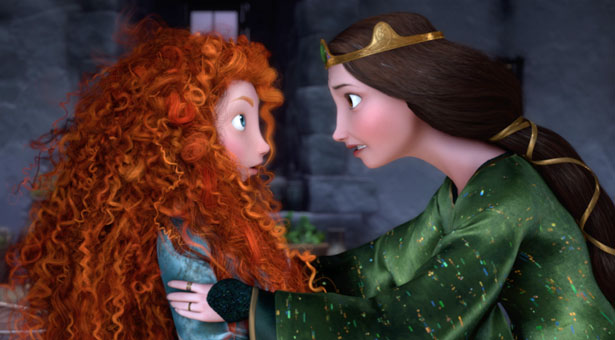
One of the reasons why Pixar's computer animation style is worth it here is evident, oddly enough, in the wild, flame-shaded hair of "Brave"'s main character, Merida. I guess hair tends to be important to Disney princesses, but short of the hair in "Tangled," a non-negotiable plot element in that film, I've never seen such important hair as Merida's. It's literally a character in the film, and in that adult sort of way that one oggles in amazement over the continual improvements made to computer animation, it's the best hair I've ever seen on an animated female character.

But "Brave" is more than the sum of its heroine's hair. It's actually the story of how Merida (voiced with a light and lovely touch by Kelly MacDonald), is expected to placate the archery-loving, tom-boy nature fostered in her by her boulder-sized, bear-hunting father, King Fergus (voiced by Billy Connolly, who I'm convinced gets first refusal on any Scottish roles), to appease the call of family history and duty taught to her by her stern mother, Queen Elinor (Emma Thompson, who joyously sells a thick Scottish accent). Merida, her queen mum explains, has reached the age where the first-born sons of the neighboring clans line up to compete for her hand in marriage. And in that traditional stubborn Disney princess way, Merida is having no part of it. Though in her defense, none of the three candidates are even remotely handsome or intelligent, and the film would have added some needed adult-like psychological content by saddling Merida with a decision to make here that is actually difficult.

Following a wildly entertaining scene is which Merida chooses archery as the format of the competition for her hand and then, in an act of wild embarrassment for her mother, shows each of the guys how it's really done, Merida selfishly storms away from her castle bedroom to brood and dream of a mother who is not so enamored with tradition and the expected roles of women. So when she meets a witch in a cottage in the forest posing as a wood-carver (her crow, one of the film's best characters, a dead giveaway), Merida makes a deal with her (Julie Walters) for the spell that any self-respecting young lady dreams of: Please make my mother change. But emotional young women are not always perfectly clear with their requests and witches are shifty, so though Merida quickly gets her wish, it's not quite what she's looking for. I don't want to spoil this with the details, because not knowing made me enjoy the film more, though I can't tell you that you won't see it coming.

Like any Disney princess movie involving a spell, "Brave"'s plot provides Merida with an opportunity to reverse the unexpected spell on her mother in two days' time, if she can only decipher the witch's metaphoric instructions, her mother in no condition to verbally assist her in the decoding. To add to the complications, her father is stuck back at the castle entertaining the three families who are growing increasingly impatient while waiting for Merida's marriage decision and begin to war with one another right there in the castle great room. And when King Fergus finally gazes again upon his transformed wife, she is unrecognizable to him - now something he hates.

Circling around the main characters of "Brave" are a chaotic mix of entertaining support players, including a long-faced clansman with Mel Gibson's "Braveheart" war paint on his face, a trio of mischievous, red-headed brothers of Merida, and, contributing frequently to this film's surprisingly frequent moments of naughtiness, a bazooka-chested nursemaid. 

What I found special about "Brave," especially sitting between my wife and my daughter while watching it, is that I'm not sure a Disney film has ever gone so deeply into mother-daughter relationships. Quite frankly, I've found the psychology underneath the whole Disney princess phenomenon to be quite damaging to young girls and have been relieved that my own daughter never lived and died on it, ditching her princess dolls years before her girlfriends did. The happy ending Princess Merida achieves by the end of "Brave" is much harder won than those achieved by her mouse house princess sisters. (Especially that Snow White, who has captivated little girls everywhere for over 70 years by laying in a coma...if that doesn't say something about feminism...)

My daughter wishes her mother was different: had different rules, wanted different things for her. She's stormed away and disobeyed. But "Brave" shows the consequences in quite scary detail without resorting to the kooky, crazy Disney villains of past films. And what restores the kingdom to wholeness at the end requires nothing less than that the queen and princess deeply, profoundly understand each other and respect each other. I think every mother and daughter should see this film together. And to make my viewing experience even more memorable, I not only went to "Brave" with my daughter and her mother, but also my wife's mother and her mother - four generations of clashing wills and estrogen-fueled disobedience.

Roger Ebert says that "Brave" "seems at a loss for what to do with [Merida] as a girl and makes her sort of an honorary boy." But with all due respect to a man who's opinion I treasure above most others, Roger Ebert does not have children.  And while "Brave" definitely comes closer to the traditional values of Disney's classic animated films, I don't agree that this shows signs of its Pixar partner losing its creative edge. Perhaps instead, it's a message that the two companies do belong together, do work well together as a true team. And maybe that took some bravery all by itself.

3.5 out of 4


Tuesday, June 19, 2012

Rock of Ages (2012)

In his liner notes for the Original Broadway Cast Recording of "Rock of Ages," the show's writer, Chris D'Arienzo, refers to musical theatre as "that wonderfully artificial non-reality where people dance around and break into song for no logical reason." Perhaps the only thing more absurd to D'Arienzo during his formative years in Michigan, he says, was the hair metal era: men with long hair, eye liner and lipstick who are straight!? So D'Arienzo said he sought to bring these two crazy worlds together, "an olive branch extending from the halls of the high school theatre department to the stoners in the parking lot."

Whether or not you enjoyed the stage version of "Rock of Ages" and whether or not you'll enjoy a filmed version of it depends largely, I think, on whether or not you find D'Arienzo's comment about his show as an olive branch to be a silly notion or poetry. And I don't think you'd find any poetry in it unless you lived it.

I lived it. I racked up countless hours of tech rehearsals as a member of the stage crew at my high school while rocking my acid-washed jeans. And while by then I had moved on a bit to R&B, I never forgot where I came from. And white kids from my neighborhood only liked R&B at all because Aerosmith and rock producer Rick Rubin introduced us to rap via RUN-DMC and Beastie Boys. Eddie Van Halen did the guitar solo on "Beat It." I loved that stuff, but as my love for music was in its most fertile bloom, as I was developing the habit of needing to hear music every day of my life, the cassette tapes said "Girls, Girls, Girls," "Look What the Cat Dragged In" and "Pride." Somewhere trapped in that awkward body was the same kind of kid dreaming of being a hair metal rock star that features prominently into the "Rock of Ages" story.

But this is not about me; it's about "Rock of Ages." And though I bring so much nostalgia to the table and came so pre-loaded to love the movie, I also try to be honest about what I see. So in the spirit of that honesty, let me say two things about "Rock of Ages":

1. "Rock of Ages" is a spectacularly average movie, veering wildly from moments of inspired genius to the kind of bad that elicits laughter from its audience - and not the good kind.

2. Tom Cruise makes "Rock of Ages," no matter how inconsistent or mediocre, worth seeing. I'll go one better. He deserves an Oscar nomination for Best Supporting Actor. I will be furious if he doesn't get one. And the only reason why I'm not telling you he should WIN the Oscar is because it's only June. This is easily one of the most inspired performances of his career.

D'Arienzo admits that he wrote "Rock of Ages" to be patterned after some specific Broadway musical cliches, and Adam Shankman (who fared much better, if you ask me, with his stage-to-screen translation of "Hairspray") keeps most of those cliches firmly in place here, despite retooling the song list of late-80s glam metal and hard rock hits by about a third of the show's jukebox playlist and completely re-imagining the character of Stacee Jaxx, a metal god and lead singer of the fictional band Arsenal who is about to embark on a solo career. Whereas the stage show plays Jaxx as a little more pathetic and slimy, Shankman and Cruise truly capture Jaxx in a god-like aura, albeit one tinged with a dose of pathetic and slimy if you don't buy into the tao of rock-or-die.

Sherrie (Julianne Hough) and Drew (Diego Boneta) are two young wanna-be-singers working at the Bourbon  Room, a club on the strip in L.A. where Arsenal got its start and will now play its final show. The bar's owner, Dennis Dupree (a really awful Alec Baldwin - and I love Alec Baldwin - in an ill-fitting wig) gets taken for a ride by Jaxx's manager (played to smarmy perfection by Paul Giamatti, though frankly he's done this kind of part too many times now for me to be amazed by it), who swipes most of the profits. But then Sherrie and Drew hit a road bump in their relationship when...song, song, song, song, song...

Ah...the film doesn't give a shit, so why should we? Because none of this matters without Cruise's Jaxx. As I said before, Cruise is that good. There will be some debate, I suspect, as to whether or not Cruise's work is a caricature of an inebriated rock star or the dramatic embodiment of one. Though its clear that Axl Rose was Cruise's primary inspiration - and he nails Rose's mannerisms down to his constant state of being tipped at a 30-degree angle to the right - I truly believe that Cruise took this role dead seriously. He's funny as hell, but that's because Cruise works his ass off for it (and when we first see Jaxx, he's quite literally ass-less). Jaxx travels eccentrically in an oversized yak fur coat with a monkey named Hey Man and greets women by grabbing one of their breasts as only a rock start could get away with without being accused of sexual assault. (He pulls this off with follow-up remarks about the quality of their...hearts.) But even with how funny he was, I saw Cruise as the one serious thing in a sea of silly. He grounds the film and gives it humanity. How much you understand Jaxx, consequently, depends a lot on how much you understand Jon Bon Jovi or Brett Michael or David Lee Roth or Vince Neil or Sebastian Bach.

I have so much respect for an actor who clearly puts in the work, and Cruise has done that. He's studied the moves and the fashion, the attitudes and the behaviors. And to top that, he studied guitar and voice, competently pulling off everything from Guns N' Roses "Paradise City" to Bon Jovi's "Wanted Dead or Alive." But mostly, Cruise accurately portrays the pure sexuality of an 80s hair metal front man, disciples all of Jim Morrison. His tight leather pants are constantly unbuttoned/unlaced at the top, the sweat always glistening in a trail down his lower back. One can almost smell the gin and perspiration whenever Cruise is on screen. He gives the film a level of pure sexuality that is shocking for a PG-13 film because it feels so much dirtier than anything that is actually said or shown.

Sadly, the blessing of Cruise is a curse, because "Rock of Ages" noticeably sags whenever he is not around; you are constantly waiting for his return. Hough and Boneta are attractive and bland; we can buy their innocence and their dreams but they are every boy and every girl (though perhaps that's by design). A scene involving Baldwin and Russell Brand as his best friend permanently decimates the memory of REO Speedwagon's "Can't Fight This Feeling." Catherine Zeta-Jones appears as a character not in the original show, and for good reason. As the wife of the mayor, she's trying to shut down the smutty strip and its loose morals. Her musical numbers are fun - remember, she won an Oscar for doing some snappy musical numbers a few years ago - but her presence here makes Bryan Cranston's work as the mayor unneeded and ridiculous; the film's plot is too light to hold the weight of the stories involving Brand and Cranston and so neither come off as remotely believable. And then there's the incomparable Mary J. Blige, who shows up for the last third of the movie to blow the roof off the musical numbers but is otherwise wasted here.

It doesn't seem like Shankman made the same definitive decisions about the film as a whole that Cruise seemed to make about playing Jaxx, and so "Rock of Ages" is all over the map with moments of camp and competence, placing it far below filmed musicals like "West Side Story" and "Chicago" and somewhere around "Nine" and "Rent." And for all of the song swapping and medley repackaging he did (check out the differences between the cast album and the film soundtrack on Amazon), couldn't Shankman at least make the decision to retire the use of "We Built This City"? First of all, that song is the LEAST hard rocking song on the planet and always has been. And second, the song was so prominently featured in last year's "The Muppets" that its more than gotten its wear in its second life. Let's be done with that one!

I could go on and on about the inconsistencies of "Rock of Ages" and dream about what it could have been and what it wasn't, but it does me more good to focus on what it is. And for me, it is a reminder of my formative years, a cinematic love-letter to the three greatest loves of my life (music, movies and musicals), and a showpiece for an actor who's never given the credit he deserves. And for those reasons alone, star rating or what not, I had a blast watching "Rock of Ages." Any movie about people who are filled with music and desperate to live out days with songs in each one can't be that bad by me. So thank you, o mediocre film musical, for reminding me that when there's music, heaven isn't too far away...

2.5 out of 4