Wednesday, December 22, 2010

Exit Through the Gift Shop (2010)

What is art, and who is an artist? These questions keep coming up when viewing EXIT THROUGH THE GIFT SHOP, a brilliant documentary directed by the famous –or infamous—British street artist known as Banksy. But what is so brilliant about the film is that these profound questions about the nature of art are not specifically addressed. Rather, they are byproducts of viewing to any members of the audience taking their viewing experience seriously enough. This makes it all the more genius that anyone who doesn’t wish to dig this deeply below the surface can just enjoy EXIT THROUGH THE GIFT SHOP as a damn funny human comedy.

Not five minutes into the film, I wasn’t sure if I would be interested. The assembly of GIFT SHOP is certainly standard; there is nothing flashy or unique about the technical aspects of this documentary. But I held in there, and not moments later, something strange and wonderful started to happen when I realized that the film’s narrative contorts in unexpected and entertaining ways. And it only got more brilliant from there.

I’m being vague, but I don’t want to give too much away, either. So let me give you the basics.

EXIT THROUGH THE GIFT SHOP BEGINS with an odd Frenchman by the name of Thierry Guetta as its subject matter. Guetta has an obsession with videotaping everything, a habit that reminded me of the Friedman family documented in “Capturing the Friedmans,” another documentary that benefited tremendously from the happy coincidence of someone filming everything with no plans for the footage until someone else with editing skills came along to make something of it. Guetta up and decides one day that he is a “filmmaker,” and selects a topic to film; he decides to make a movie about the growing phenomenon of street art. He films everything he can find and the tapes pile up in his home, never to be sifted through. His wife rolls her eyes and demonstrates tremendous patience, raising the family while Guetta pursues his pipe dream.

The dream inflates when Guetta decides to pursue the “holy grail” of street artists, the elusive and mysterious Banksy, a British graffiti expert. Surprisingly, Banksy agrees to be filmed by Guetta, though he establishes specific guidelines about how he can be filmed on camera (typically, from behind). Because Banksy’s work exists “in a legal grey area” (his words), he demands that his identity stays protected but also feels that documenting his work has value because by its nature, street art is not permanent.

That, we come to believe, is a shame. It’s hard to watch GIFT SHOP without feeling something cross over in you. While at first one understands the illegality of graffiti and its defacement of public property, the opinion becomes cloudy when this graffiti is viewed. Is graffiti art? This surely is. Soon enough, the thought of this renegade artwork being painted over seems like more of a crime than its placement there.

GIFT SHOP really hits its stride at the moment when Bansky asks Guetta what became of the hundreds of hours of footage he captured. It seems that filming the acts of graffiti was more a way for Guetta to participate in the excitement of its creation than it was a definite assignment with an expected end result. Like many artistically-inclined people, Guetta procrastinates, reveling in the foggy air of being a part of something wonderful and having nothing to show for it. But at Banksy’s urging and in deference to his invitation to film his creating process, Guetta acquiesces and edits something together. The end result, some of which is shown in this documentary, is shit. It’s spastic and incoherent. Bansky, it’s clear, is pissed.

From this point on, the film is, in a sense, hijacked by Bansky, who tries to let Guetta down easily but also firmly suggests that if Guetta loves street art so much, he should go out and create it himself. Obviously, he’s not the filmmaker he thinks he is. But to everyone’s surprise, Guetta takes his idol up on his advice, and hilarity ensues when Guetta succeeds at Bansky’s dare beyond anyone’s wildest imaginations. There’s no doubt that Banksy, who has now turned the camera on Guetta, is pissed. Guetta is so unbelievably successful that street art is elevated to the stuff of collectors who fight over pieces at Southbys.

The details of how Banksy twists things around and what happens to Guetta once he starts to create the art he once observed from behind a camera’s lens are best left to be experienced by viewing EXIT THROUGH THE GIFT SHOP. The film raises all kinds of questions, not the least of which is the struggle to decide who the butt of the joke is here. What’s clear is that Bansky is angry with Guetta, first for leading him on and wasting his time, and then for succeeding at Banksy’s own craft. But this is not an angry film, either. It’s assembled in such a puzzle-like way that the humor comes through. It’s inherently funny that Bansky, the subject of Guetta’s film, is the one who ends up releasing a film – and Guetta is his subject. Upset or not, Banksy delivers a tone that is much closer to head-shaking disbelief than anger.

EXIT THROUGH THE GIFT SHOP is the kind of film that I could write about for days and watch repeatedly. It raises so many questions about the nature of art. I, for one, thought that many of Guetta’s works were garbage and even wondered how he could be considered an artist when he had a team of people doing so much of the work. I found myself saying, “hey, I could do that.” And maybe that’s just another reason why this film is so great. I don’t consider myself an artist, but after seeing it, I was left thinking, why not me?

What will likely be the real crime in all of this is that EXIT THROUGH THE GIFT SHOP will probably miss out on major awards in favor of the Michael Moore-flavored style of screaming advocacy filmmaking that is “Waiting For Superman.” And it’s true that that film is about something important in our country right now. But important is never fun; this is. More fun than I could have possibly imagined.

4.0 out of 4

The Ghost Writer (2010)


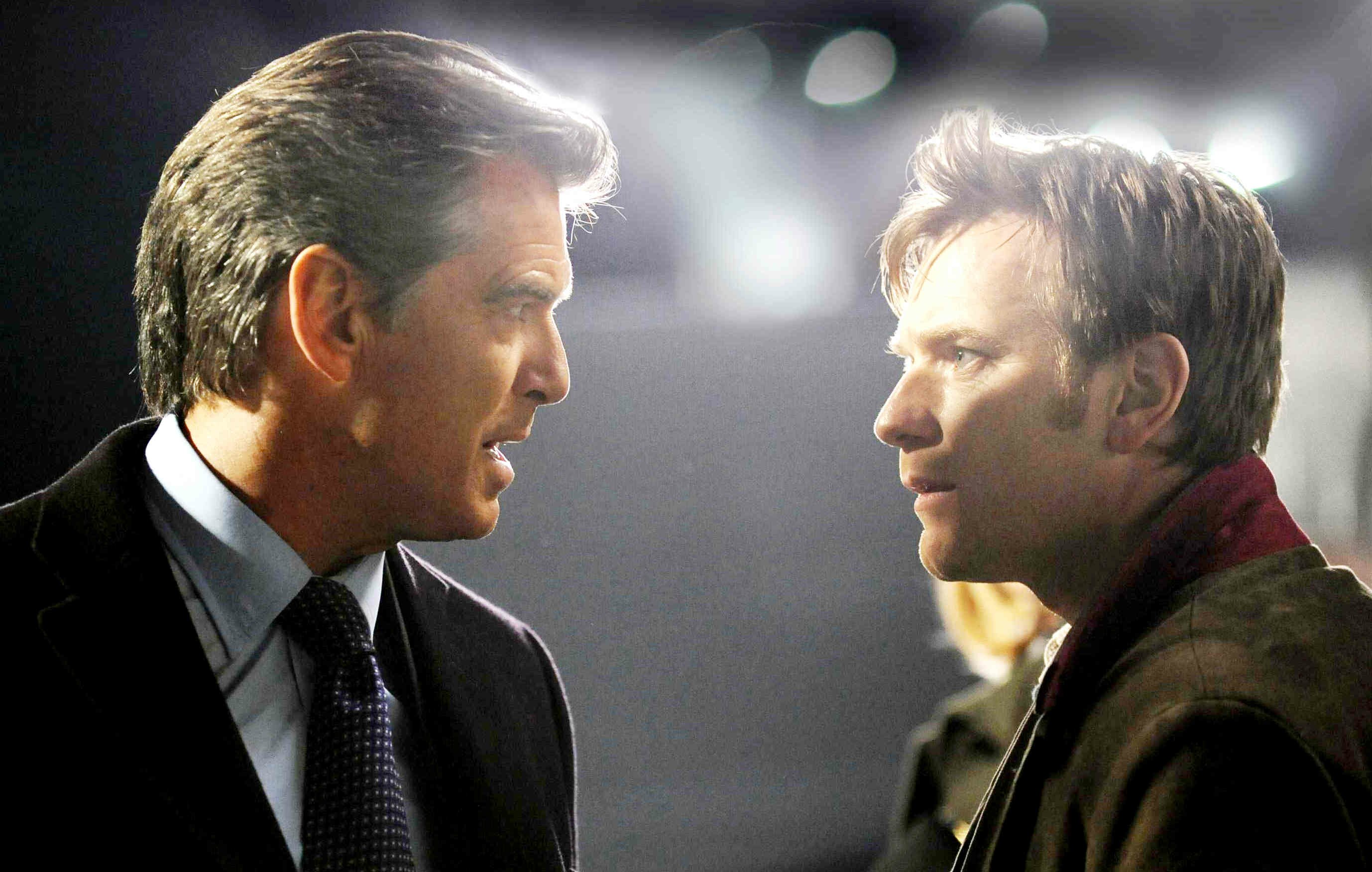
Because much of THE GHOST WRITER takes place in the ocean-front beach house on Martha’s Vineyard where a politically-doomed British Prime Minister is hiding out, it’s not hard to notice that the film is directed by a man who is, essentially, on a self-imposed sort of house arrest. The latest film from Roman Polanksi, THE GHOST WRITER was filmed and released in the time surrounding the renewed dust-up over Polanski’s sexual abuse charges from more than 30 years ago. As the famous story goes, if you want to work with one of the great international directors of all time, you have to go to him. Because he’s not coming here! Consequently, the majority of the film is shot in two indoor locations and one rather rural and barren outdoor one.

The good news is that the limits Polanski’s travel restrictions put on the visuals in his recent works only enhance the claustrophobia of what is a return to form of sorts for a master of the modern thriller. Like Polanski, the fictional prime minister Adam Lang (presumably Tony Blair) is a trapped man. This message is reinforced by scenes shot in Lang’s office where he is going over drafts of his soon-to-be-published memoir. Behind his desk is a floor-to-ceiling clear glass panel. This oversized window figuratively and literally separates Lang from the world and the lovely ocean view so closely located on the other side of the glass that it appears to be a part of the room.

Also like Polanski, Lang’s virtual imprisonment in the warehouse-style house is self-imposed. Lang and his handlers have just learned that he is being accused of a war crime. The accusation is that he authorized the illegal seizure of some suspected terrorists and then turned them over to the CIA where they were tortured. If Lang steps foot on soil that participates in the doctrines of the International Criminal Court, he will be prosecuted. See another parallel with Polanski’s life? Okay, I’ll stop.

The title of the film refers to a cleverly unnamed ghost writer played in a fantastic performance by the always-good Ewan McGregor. The ghost writer has been brought in to tweak Lang’s memoir draft into something readable and sellable, after Lang’s last collaborator was mysteriously found dead. The ghost writer takes the job, of course, before the criminal accusations are brought against Lang, and quickly discovers he’s in over his head. Sure enough, his work on Lang’s manuscript includes research and discoveries that lead him to believe that his predecessor uncovered some secrets that were meant to stay hidden.

I know that THE GHOST WRITER got good reviews when it came out, but I’m wondering why I didn’t hear that much about it, because it is a fantastic thriller and a shining example of Polanski’s narratively-jittery craft. Maybe it was overshadowed by the Polanski’s sex scandal coming back into the news. Or maybe viewers mistakenly dismissed the film as a slight work because of its quietness and downsized scope.

Whatever the reason, and with the understanding that I have miles to go before I can say that I’ve seen a majority of this year’s quality films, THE GHOST WRITER is one of the truly excellent films of the year. Those who are familiar with the modern political parallels interwoven into the story will certainly appreciate the film on another level, as will those who search for comparisons between the embattled politician and the film’s director. But I can assure you: knowledge of these things is not required to enjoy the film.

As mentioned earlier, McGregor is fantastic in the film as the ghost writer, though I got a chuckle that he manages to fit a nude scene in to this film, too, even with its PG-13 rating. Does McGregor have it written into his contract that he has to strip for everything? Seems like it.

McGregor is flanked by a solid Pierce Brosnan as Lang and engaging work by Olivia Williams as Lang’s wife, Ruth. With cameos from the likes of Eli Wallach and Timothy Hutton, the film also contains the oddities of a nearly unrecognizable James Belushi (with a shaved head) and “Sex and the City”’s Kim Cattrall as Lang’s personal assistant, complete with a truly terrible attempt at a British accent. Thankfully, this is a minor bump in the road to an otherwise excellent film.

THE GHOST WRITER is compact and taut and worthy of an audience. And it’s proof that regardless of Polanski’s personal choices, he’s still got plenty of game professionally.

3.5 out of 4

Sunday, December 19, 2010

Waking Sleeping Beauty (2009)


WAKING SLEEPING BEAUTY is not quite the expose of the behind-the-scenes dealings at the Walt Disney Studios that some might hope for, but it does dish just enough dirt to suggest that creativity comes from conflict, and the documentary is certainly a must-see for anyone who calls him or herself a Disney fan. Focusing on the animation division of the Disney company from the late 70s to the mid 90s, the film uses snippets of the creation process of films from “The Rescuers” through “The Lion King” in an attempt to demonstrate how Disney almost gave up on its animation work and then got its mojo back.

The bulk of the conflict suggested in WAKING SLEEPING BEAUTY focuses on the backstage grudges between the animation employees at Disney who felt disrespected and the leadership more concerned about making money. After the defection of animator Don Bluth and an attempted hostile takeover of the company by Saul Steinberg, Walt Disney’s nephew Roy brought in three men to stabilize the company. Frank Wells and Michael Eisner headed the company, and Jeffrey Katzenberg was placed in charge of the animation division.
Each man, but especially Eisner and Katzenberg, is shown as being out of touch to the personal needs of the underlings who slaved away at making Disney’s films. Katzenberg’s rough edges in particular are revealed here, most entertainingly in a segment regarding “The Little Mermaid” during which he is shown butting heads with lyricist Howard Ashman over the number “Part of Your World,” which Katzenberg insisted by cut. Clearly, Katzenberg was wrong on that one, and the incident acts in this film as a microcosm for a series of decisions on Katzenberg’s part that were questioned by those beneath him. Inevitably, he is painted as someone who didn’t know exactly what he was doing but got all of the credit.

To this end, WAKING SLEEPING BEAUTY is little more than a bitter brunch with the princesses. The hard work and joys of being a Disney animation employee are given equal screen time to the conflicts, and the conflicts fall more into the category of hurt feelings than anything else. One must assume that the tensions truly ran deeper than this, and Hahn assembles an impressive collection of archived interviews, but the footage hits and the disruptions more often than it proves them, which is why the moments of true tension (such as another Ashman incident involving the “Beauty and the Beast” team’s dismissal of his idea for the film’s opening sequence) are the best parts of this film.

As I said before, if you love Disney animated movies, you’ll really want to see this, and you’ll definitely learn a thing or two by doing so. WAKING SLEEPING BEAUTY feels like a “20/20” special, an hour-long look that lasts 30 minutes more than that but only goes that deep.

2.5 out of 4

TRON: Legacy (2010)


To some extent, TRON: LEGACY doesn’t make much more sense than the original film, but benefits from a very dazzling, fresh coat of paint. Indeed, the visuals of this follow-up to the landmark (if odd) 1982 film are what you would hope they would be. Combined with another engaging performance from Jeff Bridges, who reprises his role as Matt Flynn/Clu, and the pulsing scoring courtesy of Daft Punk, TRON: LEGACY is a better film than “Tron.” But it’s still a film with problems, and it’s a good film at best, but nowhere near a great one.

A prologue features Matt talking to his young son about his adventures with Encom and The Grid. Never mind that the math doesn’t quite work; the first film was 1982 and the prologue here is set in 1989, but Matt did not have a kid in the first film and suddenly has a boy who looks to be about 11. And it’s also better to not pay attention to the “de-aging” process used to make Bridges look like his 20-years-younger self. When Bridges spends the majority of the opening with his back to the camera, you have to wonder how much faith director Joseph Kosinski and his crew had in the technology. And indeed, once we get a clear look at Flynn, he appears more as a cast-away from Zemeckis’ “Beowulf” than the first “Tron.”

But back to the “story”: what little of it there is and what I can comprehend enough to share with you. Flynn goes missing from 1989 to the present day, and his son Sam (Garrett Hedlund) is a rule-breaking, thrill-seeking punk who shows little interest in his majority shareholdings of Encom, short of his delight in single-handedly sabotaging the unrolling of its latest product in a scene that inexplicably puts Sam and a fat security guard at the end of a beam that randomly and conveniently juts out from the roof of the Encom skyscraper, allowing Kosinski to film a scene that rips off “The Dark Knight.”

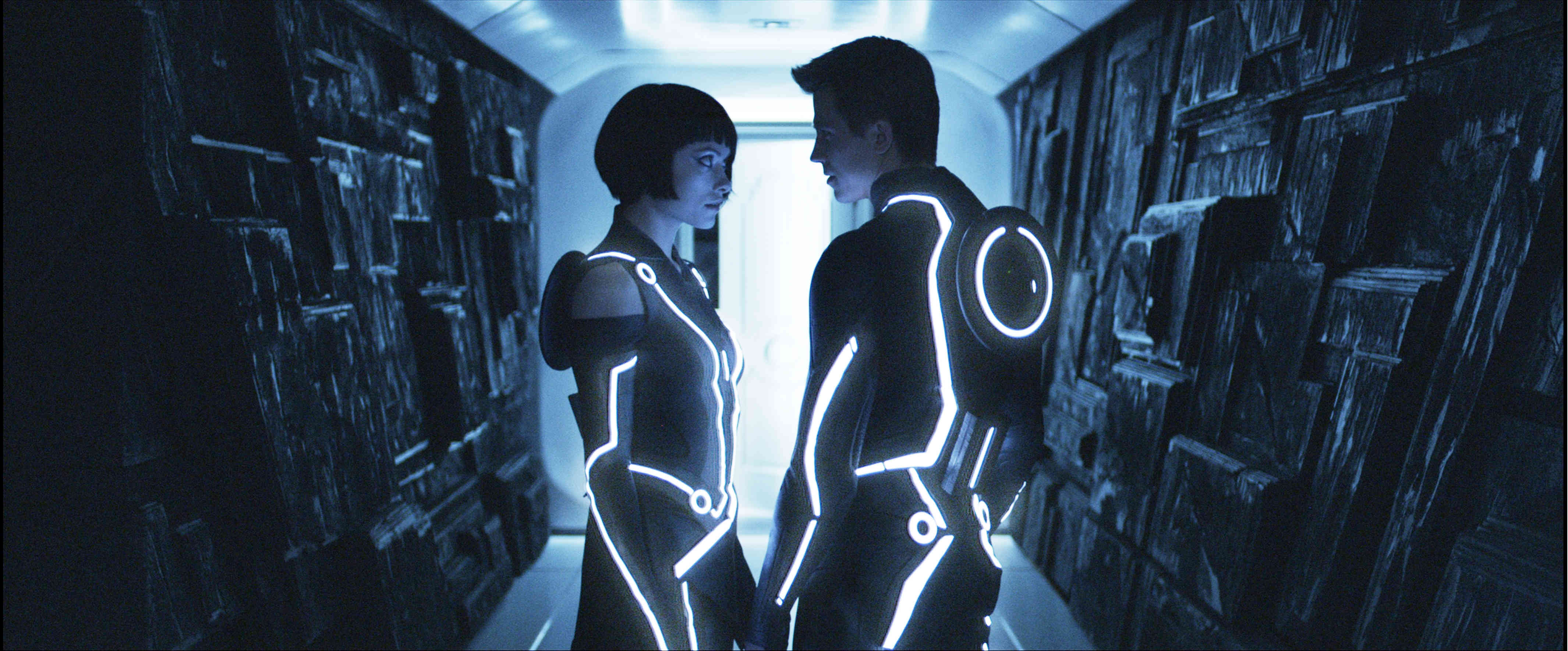
Word of a mysterious message makes its way to Sam, and this takes him to the arcade where his father once worked. There, Sam discovers Matt’s secret office and is sucked into The Grid himself. He is quickly earmarked for competing in “the games” and fitted with a cool, skin-tight black suit with neon light piping and an “identity disc.” Sam is forced to battle his way through a series of challenges (in some of the film’s best visual moments) before discovering that the guy pulling the strings is his missing father. Okay, not his actual father, but Clu, the avatar of Flynn who is now corrupt and cloying.

Sam then meets Quorra (Olivia Wilde), who takes him to his actual father, the non-digitized and 2010 Jeff Bridges with shaggy white hair and beard in a possibly-accidental reprisal of his role as The Dude from “The Big Lebowski.” Sam wants his father to come back home with him, and there’s a portal that allows them to do so that only stays open for a few hours. But The Dude – I mean Flynn – has taken to pacifism as a way of staying off the Grid and out of the sights of Clu, and warns of the dangers that will arise from their race to the portal gateway.

And here ends what I understood of the film and, frankly, what made sense of it, as Sam travels to a nightclub that could best be explained as Tron’s version of the Star Wars Cantina except that the music is a lot cooler. There, they meet Castor/Zuse, played by Michael Sheen as a clown-like David Bowie in a white pantsuit. Sheen is amusing but disturbing, and the script is so cloudy by this point that I still can’t figure out exactly what Zuse meant to the story, other than to surmise that he’s something like The Grid’s version of Oz.

By the time TRON: LEGACY comes to a conclusion, the plot has been shot full of some substantial holes, and the apparent need to leave the door open for a third Tron film seems more important than making sense of the current one.

If I sound really down on TRON:LEGACY, it’s mostly because I hoped that some screenwriter could fix the story up. The first one was somehow, miraculously, simple and confusing at the same time, and I’m sad to report that this sequel feels almost the same (save for its much more clear first half). I didn’t think the film was a complete failure. In fact, the light cycle scene was fantastic, and most of the visual effects were the sharp update I was looking for. And even though Bridges was mainly channeling his work in a role he performed since the original that is most likely the part for which he is best known, he was still engaging. Even better was the chance to see him playing both Flynn and Clu with their age and demeanor contrasts. None of the other performances were bad, but the script left all with little to work with.

I’d tell you that TRON: LEGACY is best seen and not heard were it not for the Daft Punk score, which fans of the group have been criticizing as “not Daft Punk enough,” but I thought felt perfect for what I was watching on screen. Indeed the music was a stronger element than the use of 3-D, an effect that had virtually no break-out moments of spectacle. In the end, TRON: LEGACY lives up to its title; it continues the legacy set by the first film of style over substance and visuals over script.

2.5 out of 4

Friday, December 17, 2010

Tron (1982)


When TRON hit theatres in 1982, I was a 9-year-old boy, so you can imagine that style over substance was just fine with me. A comic book geek and action figure lover who dipped into the science fiction worlds of Star Wars and cartoons like G-Force, I can remember watching TRON with my eyes bugging out of my head. I didn’t understand much of it then, but holy crap! Was it ever cool!

Steven Lisberger’s Disney project, as we now know, went on to be a colossal flop. Though a DVD of TRON was released to celebrate its 20th anniversary, it’s out of print and nearly as scarce as a DVD of “Song of the South.” It would seem that Disney was embarrassed by what I remember to be one of their first attempts to woo a more grown-up audience.

In the years since then, TRON has, of course, become something of a cult film icon. It is remembered as a film that pioneered CGI graphics in film, now a standard feature at the multiplex. But because our childhood memories are often romanticized versions of reality, I thought I’d revisit TRON in anticipation of seeing “Tron: Legacy,” which looks like Disney’s attempt to “try it again.”

I never remembered much about the plot of TRON beyond the fact that it was about a computer software programmer who gets sucked into “The Grid” during an attempt to prove that a program he wrote was his work and not that of someone who stole it and profited from it. My memory served me correctly on this, though I have to laugh that even as an adult, there is little beyond these basics that makes sense to me about TRON, even to this day.

Jeff Bridges is Kevin Flynn, whose Grid avatar (a digital presence or placeholder) is called Clu. And yes, one of the fun things about watching TRON now is thinking about how avatars are discussed in this film dating back to a year when the extent of my house’s computer technology was Pong. Flynn, a cool slacker of sorts who frequents a local arcade that bears his name (though we only see him playing in it and never running it), shows off for the patrons. Flynn is brought in by two employees at ENCOM to hack its mainframe after one of them is locked out by his shady boss. An artificial intelligence called the Master Control Program controls the mainframe, and, after sucking Flynn into its system, tries to get rid of him. Fortunately, all of Flynn’s video game-playing skills come in handy, and he makes it out alive.

This is the best I can retell the plot of TRON, because it’s still thin and complicated at the same time. But the things I remember the most of having seen TRON as a boy hold up almost 30 years later. For one thing, Bridges is great in the film. He’s always been one of my favorite actors, and this was most likely the first time I saw him on screen. He’s cocky and confident and charming as well.

And then there are the special effects, which border on cheesy but are still admirable today. The light cycles, the Grid, the light discs thrown that, when they come into contact with an avatar, shatter it to pieces. I had fun watching TRON again and enjoyed it most when I tried not to think too hard. You definitely feel like you’re in a video game when you’re watching, which is an odd juxtaposition to today’s video games, which look so life-like.

TRON came out the same year as Ridley Scott’s “Blade Runner,” so obviously 1982 was a banner year for science fiction in film. “Blade Runner,” of course, is a far superior work of science fiction in every possible way, and that’s part of why TRON is not well-respected today. But I am reminded that TRON, while emotionally and dramatically hollow, was revolutionary in its time. And watching it again nearly 30 years later accomplished the goal I hoped it would, which was to psych me up for its sequel, which I plan to consume with the modern film bells and whistles of 3-D and Imax. I hope to be a kid like this again!

1982 rating: 3.0 out of 4
2010 rating: 1.5 out of 4

Nice Guy Johnny (2010)


When Edward Burns debuted in 1995 with “The Brothers McMullen,” I was just graduating college and my love for film had grown exponentially the years prior through my work as a newspaper film critic. And when I saw this low-budget story of three Irish Catholic brothers, I fell in love. I am neither Irish nor Catholic; didn’t matter. “The Brothers McMullen,” to me, was my generation’s answer to Woody Allen. The film became, and still remains, one of my favorites, and I pledged to follow Mr. Burns to the ends of the earth (or at least to the movie theatre every time he made a film).

A big-budget follow-up, “She’s the One,” held up well for me, incorporating some of the same actors and themes and, in my mind, further cementing the “Irish Woody Allen” image of Burns. But then, for whatever reason, Burns sort of fell off the map for me. I don’t know what happened. Part of it was because his films stopped playing in theatres near me and there were times that I wasn’t even aware of a new picture from him. And for a while, he became more recognizable for an ensemble role in “Saving Private Ryan” than for any of his own work.

But I started following Edward Burns on Twitter a few months back, and was more than just a little impressed with the passion and effort Burns has put in to marketing his latest film, NICE GUY JOHNNY, a return to his true indie roots. I noticed that Burns took the time to personally respond to comments made by fans who viewed the film, something relatively unheard of coming from a known film star and director. And I started to feel guilty about having lost touch with a guy who really moved me years before. I had to get my hands on the movie.

I should probably talk about the actual film, huh? NICE GUY JOHNNY is the story of a sports talk radio DJ engaged to an uptight and controlling girl who flies to the Hamptons for a weekend to go on a job interview forced upon him by his fiancée and set up by her father. While there, his Uncle Terry (Burns), a walking case of arrested development, does everything in his power to put debauchery in the path of the calm and strait-laced Johnny (newcomer Matt Bush). These escapades lead to Johnny’s introduction to Brooke (Kerry Bishe), a lovely tennis instructor, who challenges Johnny to consider the life path he’s on and its consequences.

The best part about NICE GUY JOHNNY is that it is firmly in the camp of what I love best about Ed Burns movies, which is the conversations between characters that reveal so much about relationships. Burns has a knack, I think, for writing dialogue that is familiar and believable but still engaging and revealing. And while he takes the lines for his own character a little over the top, it’s fun to see him having fun on screen with a slightly silly part.

Unfortunately, NICE GUY JOHNNY also treads fairly worn ground. It is another entry in a multitude of stories about a guy with a dream being controlled by a woman who’s not right for him but he’s the only one who can’t see it until he meets a girl that the audience likes better instantly, leaving us to wait in frustration for him to come around to our way of thinking.
The lead performances in NICE GUY JOHNNY are charming but not particularly magnetic. Bush is a doe-eyed frat boy who looks more like a party animal than an uptight and faithful boyfriend, though this aspect of Burns’ casting of him was, for me, one of the most refreshing things about the film. Likewise, Bishe is pretty in a plain way, and though it’s easy to like her more than Johnny’s fiancée Claire (Anna Wood), it’s not like she’s a forbidden movie star of a girl. Then again, I think Burns is smart enough to have cast her specifically for that reason, too. As clichéd as I found this story to be, it’s a credit to Burns that just about everything here is quite believable.

Burns himself plays a character not unlike the one played by Campbell Scott in “Rodger Dodger,” another one of my all-time favorite indie films. But Uncle Terry is much crazier and childish than Scott’s sophisticated womanizer in that film. And Burns is, I think, at his acting best when he’s allowed to smile and use his considerable charm.

Ultimately, I found NICE GUY JOHNNY to be a pleasant but slight viewing experience, but I haven’t even mentioned the most engaging thing about the film yet, which is its marketing and distribution. I did mention that Burns himself has taken to Twitter to promote the film, which played at various film festivals as is customary for many independent filmmakers. But what I haven’t added yet is the fact that Burns has eschewed a movie theatre release of NICE GUY JOHNNY in favor of a relatively new distribution strategy that I find both ballsy and shrewd—he is using video on demand (such as Comcast/X-finity), iTunes and Netflix, in combination with DVD sales and bundle sales of the film with other memorabilia related to the film. In other words, Burns is putting the movie right in people’s houses immediately. And while he’s not the first to do this, he is attacking this strategy with gusto and I admire him tremendously for it…so much so that I went straight to my Netflix account and lined up all of those Ed Burns-directed films that I missed, the ones that fell through the cracks, for a Burnsy marathon.

I sure hope that Burns finds his current business model to be a successful one. It’s especially perfect for quiet little stories like NICE GUY JOHNNY that play nicely on computer monitors and flat screen TVs. I’m not sure I would have found NICE GUY JOHNNY to be worth a trip to the multiplex, but it was certainly worth a click of the mouse. In his own way, Edward Burns might well be on his way to being the filmmaking equivalent of a short story writer, telling low-key but watchable stories bursting with humanity on a frequent basis in a manner that, like a good book, puts the stories right in our laps at home.

Film: 2.5 out of 4
Distribution and marketing campaign: 4.0 out of 4

Friday, November 26, 2010

The Social Network (2010)


I feel very comfortable calling THE SOCIAL NETWORK a thoroughly watchable, incredibly written, strongly acted and excitingly paced film, but I find myself falling short of calling it brilliant, incredibly directed, or “the best film of the year.” I’m wondering if I’d feel differently had I seen the film at the height of its just-released hype. Instead, I waited to see it until after I had already seen films like Danny Boyle’s “127 Hours.” And, having done so, I don’t see the strength in David Fincher’s direction that I see in Boyle’s film (just to name one).

THE SOCIAL NETWORK is being courted as this year’s Best Picture winner. I can understand why in the sense that it has that zeitgeist-y quality in terms of its topic. But I don’t know if it really captures our time the way everyone thinks it does. Yes, it deals with what has perhaps become the most significant communications tool of the last half-century or more. And Fincher captures the present day backstabbing and paranoia of the business world with bite and clarity. But do you know what the film never really does at all? It never really dives into the impact that Facebook has had on culture, on how we communicate. Its version of psychology is stopped short at creator Mark Zuckerberg’s motivations for starting the website in the first place.

To be sure, it’s an interesting story of a man dancing with genius as motivated by spite, and many have drawn parallels between this film and “Citizen Kane.” I can see where the comparison comes from, but I disagree with it. Zuckerberg’s no-longer-girlfriend is no Rosebud. And Fincher, as good of a director as he is, is no Orson Welles. There are no jaw dropping visual moments here, while Kane is littered with them. This leaves the connections, if in fact there are any, on the level of story parallels.

I struggled for a while after seeing THE SOCIAL NETWORK to figure out what specifically Fincher brought to the table as a director with a typically authorial tone, because to me, the film was much more an example of the work of Aaron Sorkin, its screenwriter, whose trademark razor-sharp dialogue is the highlight of this production. Upon further reflection, I can certainly recall that Fincher darkness, the shadowy, noir-like paranoia that make most of his great films so good. And yet despite all of Fincher’s talents as a director, I found myself struggling to believe that only he could deliver this film in such a manner while, in contrast, I can’t imagine anyone else having helmed “Seven,” “Fight Club” or “Zodiac.” There are some stylistic similarities, but not enough. I think filmgoers are being blinded by the fact that a great director has intersected with the cultural story of the moment. But I was much more entertained by the dialogue than by any directorial decision, camera set-up or editing choice.

If anything makes me happy about THE SOCIAL NETWORK, it’s that audiences now know Jesse Eisenberg, an actor I have been raving about for damn near a decade. Eisenberg hit my radar all the way back in 2002 in his debut film role as the co-star of the brilliant and under-appreciated “Roger Dodger,” which would be on my list of favorite films of the past decade. His follow-up roles in films like “The Squid and the Whale,” “Adventureland” and “Zombieland” were some of the best things about those films, and it seems like with his role in THE SOCIAL NETWORK, the rest of America is finally catching up to him. Eisenberg is not, thank you very much, Michael Cera’s twin brother. What he is, though, is the perfect vehicle for Sorkin’s dialogue, as the film’s opening scene demonstrates. It’s a credit to Eisenberg alone, I think, that you never quite hate Zuckerberg even though logic tells you what an asshole he is.

Nothing about THE SOCIAL NETWORK is weak. The supporting cast—particularly the work of Andrew Garfield and Justin Timberlake—is memorable and realistic. The production values are stellar. And if the film racks up the accolades during the award season ahead, those kudos won’t be wholly unjustified.

But I’m going to stand out on a limb, perhaps alone, and look back on THE SOCIAL NETWORK as solid film entertainment as opposed to the second coming. I enjoyed it very much, but I thought it could have been so much more. Four-star films are movies that couldn’t be better. Three-star movies are quality entertainment and memorable pieces of film craft. THE SOCIAL NETWORK is the latter.

3.0 out of 4