Saturday, August 18, 2012

The Campaign (2012)

For the first time in my life, I drove to a movie theatre and laid down money to see a film starring Will Ferrell. Having been a huge fan of his work on "Saturday Night Live," it's been my disappointed belief ever since that Ferrell's genius is limited to bursts of no more than 10 minutes, some sort of Faustian bargain to make him the funniest guy on the planet in exchange for the brevity of wit that would forever curse him to never carry a film.

Believe me, I tried to laugh at Farrell's movies, though I never trusted him - or them - enough to see them in the theatres. I decided that when Farrell is not the focus, such as in "Old School," his film work seems to stand up better. And as a news and media guy, I've wondered again and again why the beloved "Anchorman" is so not funny to me.

So I don't know what possessed me to want to take a chance on "The Campaign," but I did. And either I was exhausted when I saw it or just genuinely open to it, because I really enjoyed it. Like a lot. Like more than I'd like to admit. Co-starring the also funny-quirky Zach Galifianakis,"The Campaign" is a sly satire on the absurdity of the political campaign season in America.

Ferrell plays congressman Cam Brady, a smug political asshole preparing to run unopposed for reelection to his North Carolina seat, who is shockingly and suddenly challenged for it by a pouf of a man named Marty Huggins, a doughy, unimposing family man who's backed by a super pac with dubious capitalist and corporate interests to take the seat. Huggins, of course, is genuinely interested in helping his community and is unaware of the source of his growing power to challenge Brady.

The campaign season becomes a game of one absurd one-upsmanship, with Brady subjecting Huggins to sleazy acts of embarrassment and Huggins learning to dig back thanks to the the arrival of Dylan McDermott as a macho mercenary of a campaign manager, who begins his work by first replacing everything in Huggins' home to improve his image, even going so far as to exchange the two family pugs for golden labs, which test market better with voters.

The personal attacks on each other go to such great and childish lengths that I wouldn't dare spoil them for you by listing them here, because the fun of watching "The Campaign" is knowing that each act of retaliation will only be more ridiculous than the last and waiting to see what specifically we will get.

The film has a supporting cast that isn't being advertised enough in the shadow of its two huge lead stars, but support work by McDermott, Jason Sudeikis (as Brady's campaign manager),and Dan Ackroyd and John Lithgow (as scheming and dubious revenue sources to the Huggins campaign) are just additional reasons why this particular film holds up a little better than Ferrell movies in the past.

I've read more negative reviews of "The Campaign" than positive, and what I've found interesting is that most of the negative reviews express disappointment over the fact that the film had the opportunity to be a sharp satire on American politics but wasn't. They propose that to see it as such is to be creating subtext that director Jay Roach never truly put there. What movie were they watching?

Take it from me: that satire is there, and perhaps the reason I liked "The Campaign" is because it's one of the only times I can think of when Ferrell's on-screen insanity has been grounded by something truly topical. His eccentric characters are always to be laughed at because they are so out there. But you can't watch this film without nodding your head with the familiarity that Cam Bradys exist right now, everywhere, all over America. They are perfectly-coiffed, handsome, hollow shells of men being filled by ideas by those who put up the dollars to fund their campaigns. And only the insane level of farce that this film goes to can achieve a sense of comedy when, in reality, lesser versions of the same games are actually being played out there, and they are not funny at all.

Entertainment Weekly critic Owen Gleiberman is wise to point out, I think, that director Jay Roach is not one of Ferrel's traditional collaborators and that Roach has previously directed the political HBO films "Recount" and "Game Change." So although this is also the man who brought us Austin Powers, he knows what he's doing when it comes to exploring the American political landscape in terms of the aspects of it that make us scratch our heads.

By the time "The Campaign" is over, we reinforce the idea that some of our elections are choices between bad and worse, and Roach ultimately calls voters on the carpet, too, for the decisions they ultimately make. And for me, the stroke of genius to lay a foundation of truly relevant and grounded social satire underneath Ferrell's largely unaltered buffoonery was enough to make me say that I paid for a Ferrell movie...and I liked it!

3.0 out of 4

Friday, August 3, 2012

Ted (2012)

Since my formative years occurred during the 1980s, I've got some fairly romanticized memories of that decade. The older I get, in fact, the more I think the 80s was the greatest decade, like ever. This, of course, cannot possibly be true, but it's my reality. Nor could it be true that that a slightly-altered version of one of that decade's greatest toys, Teddy Ruxpin, could carry a modern-era, feature-length film. Here, I'm more realistic; it can't. Not even in the hands of the one guy who could actually pull it off, fellow 80s-lover, Seth MacFarlane. His teddy-bear-comes-to-life tale, "Ted," is a great idea with some outrageously funny moments, but it's difficult not to watch and wonder why the film wasn't more clever still. "Ted" is all empty calories: you laugh and laugh and then in between jokes wonder why the movie is so lame.

The big let-down in "Ted" is not the humor, which is as outrageously politically incorrect as one would expect from the creator of "Family Guy." Instead, it's the plot, which is so pedestrian that any remotely alert viewer who has ever seen anything will figure it out rather quickly and be completely accurate with the prediction. "Ted" tells the story of a loner boy named John who receives a huge teddy bear for Christmas one year as a boy and makes a wish that the bear, which he names Ted (of course), will be his friend forever. The bear comes to life to accept this agreement.

The one funny plot hook of the film - its one clever conceit - is the exploration of what would happen later in life when that boy is now a man. What happens to the bear? "Ted" flashes forward to show us a now 35-year-old John (Mark Wahlberg), who is barely what you could call a man, but still doing almost everything with Ted (voiced by MacFarlane in a vocal performance sometimes too similar to his Peter Griffin). After all, how do you just box up, donate, or otherwise get rid of a teddy bear who's come to life?

And why would you want to? Ted is a hard-core party animal: a sex-crazed, beer-guzzling bear who scores the best pot in the neighborhood, makes jokes about 9/11, and calls fat kids "Susan Boyle." He's always been the life of John's party, and John's party has always revolved around Ted. So when John, the biggest film case of arrested development I've seen in years (and there are tons of films with these kinds of characters around right now) tries to navigate his romance with Lori (Mila Kunis) with Ted looking on, well, it's clear that the film is headed for a very stereotypical "it's either me or him" ultimatum on the part of the girl who has waited four years for a marriage proposal, and for her man to grow up. I can stop summarizing the plot here, because you already know that John will make her promises and that Ted will interfere and screw them up. John will be forced to choose between the two and will choose the girl, and then a dejected best friend will cut off communication with him for a while but ultimately the friends will be reunited by some sort of conflict that will end with the three of them happily, if inexplicably, accepting each other.

Couldn't the brilliant writer of "Family Guy" come up with something better than this? Film critic Brad Brevet, who disliked "Ted" much more than I did, makes a fantastic point when he reminds us that MacFarlane, on his TV show, "has a knack for pointing out the weaknesses in films and television shows and yet when it comes to creating a film of his very own he decides on the most cliched storytelling available to him." I couldn't summarize the problem with "Ted" better, so I won't try to. The film feels like a cheap excuse to string some jokes together, a scenario rather than a plot. And that's a big disappointment.

What I found far less disappointing, however, was the humor in "Ted," unapologetic in its pervasive use of crude, offensive and culture-skewering humor. Maybe it's because I am only three months older than MacFarlane that I share much of his sense of sarcasm and taste for what's funny. So a scene featuring actor Giovanni Ribisi dancing in front of a TV to a Tiffany music video, for instance, is as funny to me as it is to him. And MacFarlane's rapid-fire use of pop culture references, some of which might be obscure to teenaged fans of "Family Guy," are firmly within my wheelhouse and memory bank of childhood, meaning that they strike me right at the funny bone in an instant, with no need for further context clues.

The dialogue exchanges between John and Ted give the film its best moments. In one particularly funny conversation, Ted tells John that he's met a girl with a "white trash name" and they turn it into a game, John running through over two dozen names without taking a breath. What's even funnier is that most of the names are relatively common, thus meaning that MacFarlane is calling many of "Ted"'s female audience members "white trash" by proxy. Not that much of "Ted"'s audience is female; "Ted" joins "The Dark Knight Rises" as an oasis for movie-going men in the summer of "Magic Mike."

I laughed so hard at "Ted" that I think I'd eventually need to see it again to get some of the jokes I missed. In fact, while reviewing some of the great quotes from the film on IMDB, I saw at least three that I didn't even remember. No doubt I was in the middle of punching my best friend's arm in the movie theatre or stabilizing my rolling office chair in the upscale eatery-theatre to prevent my friend from shoving me down the aisle flight of stairs in a fit of laughter. Ultimately, "Ted" is not only about a man who won't grow up enough to not need his teddy bear, but a man who won't grow up enough to work his way beyond ironic, childhood pop culture humor. And while I can't relate to the film's pervasive use of drug humor, I can certainly relate to that.

2.5 out of 4


Sunday, July 29, 2012

The Dark Knight Rises (2012)

In an attempt to balance the dual forces of comic book geek and film buff fighting within me, I feel like I was one of the only people who gave 2008's "The Dark Knight" less than a four-star review. Yes, Heath Ledger was transcendent as The Joker - deserving of that Oscar no matter what the back story of his death added to it - and yes, the film deserved the Best Picture Oscar nomination it never got.

But no, it wasn't the be-all-and-end-all movie that everyone said it was. It was too long. It did not end well. The Harvey Dent storyline needed tweaking. The film's message was too heavy-handed and hammered home. It was an excellent film, but not one for the ages.

So now that I've seen the final film in Christopher Nolan's Batman trilogy, "The Dark Knight Rises," I'm laughing to myself that once again, I'm at odds with most of the other critics on this one. Most every review I've seen has said that this film doesn't measure up to "The Dark Knight." And I guess I agree with that. Because I think it surpasses it. THIS is the four-star Batman movie, and it's not even close. And I'll tell you why.

Now before I get too far into it, I'll address what might be perceived on the part of some readers as a flaw in my logic: the running time issue. Because yes, "The Dark Knight" rises comes close to being a half-hour longer than "The Dark Knight," and just barely in the double-digits away from the dreaded three-hour mark, which is about all I can take from a movie, and I said that "The Dark Knight" was too long. But I felt that way because that film did not end in the right place. It had a logical ending, I thought, and then tacked on more. I dare anyone to try and convince me that the final half hour of "The Dark Knight Rises" made the film feel a half-hour too long. In fact, it's probably most viewers' favorite part. They might say instead that it's the opening half-hour that deserves chopping. I happen to disagree with that too. But suffice it to say, this film was deliberately and carefully timed, and as long as it needed to be.

It's tradition to include a plot summary in a film review, but I don't want to give away much. Let me just remind you of a few basics needed going into this film, whether or not you've seen either of its predecessors or have read any Batman comics. It's eight years after the conclusion of "The Dark Knight," and Bruce Wayne (Christian Bale) is in a Howard Hughes-like seclusion in a section of Wayne Manor mostly covered in sheets, as if he's not only recovering from his days as Batman but somehow ashamed of his real identity as a Wayne. Batman, in a deal brokered with Commissioner Gordon (Gary Oldman) took the fall for Harvey Dent, the spirit of reform in Gotham City who was, in truth, its newest villain Two-Face, because both men agreed that the people needed to maintain his image of martyred idealism to keep hope alive in their fragile city.

A legal mandate bearing Dent's name has put hundreds of criminals behind bars, but not Bane (Tom Hardy), a menacing, hulkish vigilante who wears a face mask that provides him with chemical relief from otherwise unbearable amounts of pain he's endured in his past. Bane, it turns out, is, like Wayne, a former trainee of Ra's Al Ghul, but one who aims to bring the plan of the League of Shadows to fruition. The plan, of course, involves the complete destruction of Gotham City.

Wayne is ultimately convinced to re-don the cowl thanks to gentle nudges from both the Commissioner and one of his officers, the young and idealistic John Blake, with a connection to Bruce that's too good to spoil. And perhaps Bruce receives additional encouragement to reappear as Batman thanks to the arrival of Selina Kyle (Anne Hathaway), a sexy and seriously accomplished cat burglar/jewelry thief (known in Batman folklore - but never expressly here - as Catwoman).

The decision to reappear as Batman is gently but firmly protested by Bruce's faithful butler Alfred, and Michael Caine's performance as the wise servant is the acting highlight of this film and the element that gives "The Dark Knight Rises" the kind of pure emotional core than neither of the previous installments could claim. I dare say that Caine's work here is every bit as good in its own way as was Ledger's in the last film, but because Caine already has Oscar bookends at home and is still alive, he probably won't receive proper recognition for it.

Neither will Hathaway, who surprises with the best film version of Catwoman ever, with apologies to Michelle Pfeiffer, who had me at attention as a young man with her take on the role in Tim Burton's "Batman Returns." Hathaway is not only all confidence and curvy swagger, but her very movements are borderline-erotic and her quips account for the majority of the light moments in an admittedly dark, heavy, and humorless film. She was shockingly good, exceeding all of my expectations for that character.

Critics are already saying that Hardy's Bane lacks the charisma of previous Batman villains. I find this fight to be unfair, as everyone knows that The Joker is the greatest of all of the Batman villains and only those who followed the comic into the 1990s and beyond will even be aware of who Bane is. Those readers will also be disappointed in aspects of the character; his reliance upon a serum known as "venom" to manage his pain is not included at all in this film, and the issue of the what and why surrounding his mask is not satisfactorily explored. And then, of course, there's the challenge facing an actor to perform behind a sawed-down version of Darth Vader's mask, limiting Hardy to eye movements and body language and a voice that, as Rolling Stone critic Peter Travers said, "sounds like Sean Connery behind an air conditioner." This is true, but I was able to understand it. In fact, it's no worse than Bale's Batman voice. And to those who think Bane is boring, I say that revelations about the character in the film's final act render him a compelling and satisfying adversary.

I could go on and on in essays about this film, but I'll end with my list of five reasons why "The Dark Knight Rises" is the four-star film in Christopher Nolan's Batman oeuvre, and then open the floor for debate:

1. It's the most emotional of the three films. Mostly because of Alfred, but this is also Bale's best work as Wayne/Batman, the recently Oscared actor giving his character an emotional core to match the weight of that mythical back story.
2. Selina Kyle elevates the film. In a sense, she gives Bruce someone to mentor. Why is she worth mentoring? It would seem that she isn't. But Bruce clearly sees something in her, and audiences are made to agree as the film wears on. I don't think this would be the movie that it is without the character, or without the way Nolan and Hathaway specifically handle her vs. how she's been used in past tellings of the story.
3. The ending is perfect. Yes, I know there will be debate. And I will also admit that for as go-go-go as the last half hour was, the final ten minutes were so full of information that I was exhausted at the end and had to talk out what just happened with a friend. But I've also rarely seen a finish that so completely ties story elements up while still making it possible for more Batman films to be made by other directors in the future.
4. The themes are more satisfying. Yes, there are a lot of them in here, and some might argue too many. But I think that made it better for me. Nolan was too bombastic with the themes in "The Dark Knight." This time, I think he was a bit more ambiguous with some of them, such as the nature of Batman as an idea vs. a specific person. And it's true that he shoots for a take on modern politics when Bane upends the stock exchange, resulting in Wayne's loss of his fortune. And that political message seems be that the ultra-rich have a moral responsibility to step up and give more away. But that's a message as liberal as Obama's tax proposals and as conservative as Warren Buffet's pleas to be taxed more. It's timely.
5. This is Nolan's best direction. Aside from some bizarre scene fade-outs that left me scratching my head, I've never seen Nolan do more with his widescreen, IMAX-filmed photography, particularly breathtaking in a sequence where Bane and his crew seal off the city in the midst of a nuclear bomb threat. He also, for the first time, finds a way to control the bombastic score of Hans Zimmer, at one point noticeably dropping the score completely during an intense hand-to-hand combat scene between Batman and Bane, allowing the natural sounds of the scene to propel the action in a way that reminded me of the climax of "The French Connection." And in true Nolan style, most everything important to the plot of the film is revealed to the audience many minutes prior to the moment where that element comes into play. It's also worth noting that, like "Inception," Nolan allows this movie to contain more ambiguity than the previous films, which I think opens this movie up for more interesting discussion than the previous films.

I don't want anyone to think that "The Dark Knight Rises" is a perfect film, because it isn't. It's simply the best film of the trilogy. To some degree, this film takes a hit where plot logic is concerned, as characters seem to appear wherever they need to be to further the action and we never see or understand how they got there so quickly or easily. Fortunately, the character work is so excellent that this silly aspect is more forgivable.

I never even made it to discussing the work in this film from Marion Cotillard, far and away one of the best actresses working in film today and playing a character who provides an exciting link to Batman books of the past. Nor have I (and this by choice) fully analyzed how wonderfully Nolan uses Joseph Gordon-Levitt and how important I think that character was to the film, in some ways this movie's version of Harvey Dent, but a better one.

But to each his own. "Batman Begins" was a thrilling origin story, and "The Dark Knight" a sequel with some flawed structure but the best villain. But if you ask me, the thematic deconstruction of the archetypal superhero, the debate over the value of the vigilante, and the responsibility of the individual with any means to contribute to the improvement of society - none of these ideas has ever been as brilliantly articulated as it is here. The word "rise" is heard many times throughout the film, and the image of rising a not-so-light motif. But when all is said and done, Nolan's final Batman film lives up to its title.

4.0 out of 4

Sunday, June 24, 2012

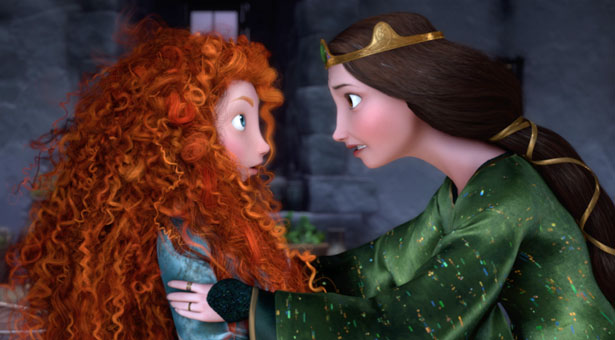
Brave (2012)

For any of you who have ever been confused about the relationship between Disney and Pixar - Is Pixar separate? Is it a part of Disney? - "Brave" is where the two entities fully merge into one. It's a classic Disney animated princess film in the nimble hands of the wildly imaginative Pixar animators. It's one of the first times that, save for a few elements, I'm not sure that the Pixar style of animation made the film any better than a traditionally-animated film would have been. And, so that I get it out of the way quickly, it's an excellent film and now is not the time to decide where it fits in the Pixar canon and say that it's not one of their best (because it's not one of their worst, either).

One of the reasons why Pixar's computer animation style is worth it here is evident, oddly enough, in the wild, flame-shaded hair of "Brave"'s main character, Merida. I guess hair tends to be important to Disney princesses, but short of the hair in "Tangled," a non-negotiable plot element in that film, I've never seen such important hair as Merida's. It's literally a character in the film, and in that adult sort of way that one oggles in amazement over the continual improvements made to computer animation, it's the best hair I've ever seen on an animated female character.

But "Brave" is more than the sum of its heroine's hair. It's actually the story of how Merida (voiced with a light and lovely touch by Kelly MacDonald), is expected to placate the archery-loving, tom-boy nature fostered in her by her boulder-sized, bear-hunting father, King Fergus (voiced by Billy Connolly, who I'm convinced gets first refusal on any Scottish roles), to appease the call of family history and duty taught to her by her stern mother, Queen Elinor (Emma Thompson, who joyously sells a thick Scottish accent). Merida, her queen mum explains, has reached the age where the first-born sons of the neighboring clans line up to compete for her hand in marriage. And in that traditional stubborn Disney princess way, Merida is having no part of it. Though in her defense, none of the three candidates are even remotely handsome or intelligent, and the film would have added some needed adult-like psychological content by saddling Merida with a decision to make here that is actually difficult.

Following a wildly entertaining scene is which Merida chooses archery as the format of the competition for her hand and then, in an act of wild embarrassment for her mother, shows each of the guys how it's really done, Merida selfishly storms away from her castle bedroom to brood and dream of a mother who is not so enamored with tradition and the expected roles of women. So when she meets a witch in a cottage in the forest posing as a wood-carver (her crow, one of the film's best characters, a dead giveaway), Merida makes a deal with her (Julie Walters) for the spell that any self-respecting young lady dreams of: Please make my mother change. But emotional young women are not always perfectly clear with their requests and witches are shifty, so though Merida quickly gets her wish, it's not quite what she's looking for. I don't want to spoil this with the details, because not knowing made me enjoy the film more, though I can't tell you that you won't see it coming.

Like any Disney princess movie involving a spell, "Brave"'s plot provides Merida with an opportunity to reverse the unexpected spell on her mother in two days' time, if she can only decipher the witch's metaphoric instructions, her mother in no condition to verbally assist her in the decoding. To add to the complications, her father is stuck back at the castle entertaining the three families who are growing increasingly impatient while waiting for Merida's marriage decision and begin to war with one another right there in the castle great room. And when King Fergus finally gazes again upon his transformed wife, she is unrecognizable to him - now something he hates.

Circling around the main characters of "Brave" are a chaotic mix of entertaining support players, including a long-faced clansman with Mel Gibson's "Braveheart" war paint on his face, a trio of mischievous, red-headed brothers of Merida, and, contributing frequently to this film's surprisingly frequent moments of naughtiness, a bazooka-chested nursemaid. 

What I found special about "Brave," especially sitting between my wife and my daughter while watching it, is that I'm not sure a Disney film has ever gone so deeply into mother-daughter relationships. Quite frankly, I've found the psychology underneath the whole Disney princess phenomenon to be quite damaging to young girls and have been relieved that my own daughter never lived and died on it, ditching her princess dolls years before her girlfriends did. The happy ending Princess Merida achieves by the end of "Brave" is much harder won than those achieved by her mouse house princess sisters. (Especially that Snow White, who has captivated little girls everywhere for over 70 years by laying in a coma...if that doesn't say something about feminism...)

My daughter wishes her mother was different: had different rules, wanted different things for her. She's stormed away and disobeyed. But "Brave" shows the consequences in quite scary detail without resorting to the kooky, crazy Disney villains of past films. And what restores the kingdom to wholeness at the end requires nothing less than that the queen and princess deeply, profoundly understand each other and respect each other. I think every mother and daughter should see this film together. And to make my viewing experience even more memorable, I not only went to "Brave" with my daughter and her mother, but also my wife's mother and her mother - four generations of clashing wills and estrogen-fueled disobedience.

Roger Ebert says that "Brave" "seems at a loss for what to do with [Merida] as a girl and makes her sort of an honorary boy." But with all due respect to a man who's opinion I treasure above most others, Roger Ebert does not have children.  And while "Brave" definitely comes closer to the traditional values of Disney's classic animated films, I don't agree that this shows signs of its Pixar partner losing its creative edge. Perhaps instead, it's a message that the two companies do belong together, do work well together as a true team. And maybe that took some bravery all by itself.

3.5 out of 4


Tuesday, June 19, 2012

Rock of Ages (2012)

In his liner notes for the Original Broadway Cast Recording of "Rock of Ages," the show's writer, Chris D'Arienzo, refers to musical theatre as "that wonderfully artificial non-reality where people dance around and break into song for no logical reason." Perhaps the only thing more absurd to D'Arienzo during his formative years in Michigan, he says, was the hair metal era: men with long hair, eye liner and lipstick who are straight!? So D'Arienzo said he sought to bring these two crazy worlds together, "an olive branch extending from the halls of the high school theatre department to the stoners in the parking lot."

Whether or not you enjoyed the stage version of "Rock of Ages" and whether or not you'll enjoy a filmed version of it depends largely, I think, on whether or not you find D'Arienzo's comment about his show as an olive branch to be a silly notion or poetry. And I don't think you'd find any poetry in it unless you lived it.

I lived it. I racked up countless hours of tech rehearsals as a member of the stage crew at my high school while rocking my acid-washed jeans. And while by then I had moved on a bit to R&B, I never forgot where I came from. And white kids from my neighborhood only liked R&B at all because Aerosmith and rock producer Rick Rubin introduced us to rap via RUN-DMC and Beastie Boys. Eddie Van Halen did the guitar solo on "Beat It." I loved that stuff, but as my love for music was in its most fertile bloom, as I was developing the habit of needing to hear music every day of my life, the cassette tapes said "Girls, Girls, Girls," "Look What the Cat Dragged In" and "Pride." Somewhere trapped in that awkward body was the same kind of kid dreaming of being a hair metal rock star that features prominently into the "Rock of Ages" story.

But this is not about me; it's about "Rock of Ages." And though I bring so much nostalgia to the table and came so pre-loaded to love the movie, I also try to be honest about what I see. So in the spirit of that honesty, let me say two things about "Rock of Ages":

1. "Rock of Ages" is a spectacularly average movie, veering wildly from moments of inspired genius to the kind of bad that elicits laughter from its audience - and not the good kind.

2. Tom Cruise makes "Rock of Ages," no matter how inconsistent or mediocre, worth seeing. I'll go one better. He deserves an Oscar nomination for Best Supporting Actor. I will be furious if he doesn't get one. And the only reason why I'm not telling you he should WIN the Oscar is because it's only June. This is easily one of the most inspired performances of his career.

D'Arienzo admits that he wrote "Rock of Ages" to be patterned after some specific Broadway musical cliches, and Adam Shankman (who fared much better, if you ask me, with his stage-to-screen translation of "Hairspray") keeps most of those cliches firmly in place here, despite retooling the song list of late-80s glam metal and hard rock hits by about a third of the show's jukebox playlist and completely re-imagining the character of Stacee Jaxx, a metal god and lead singer of the fictional band Arsenal who is about to embark on a solo career. Whereas the stage show plays Jaxx as a little more pathetic and slimy, Shankman and Cruise truly capture Jaxx in a god-like aura, albeit one tinged with a dose of pathetic and slimy if you don't buy into the tao of rock-or-die.

Sherrie (Julianne Hough) and Drew (Diego Boneta) are two young wanna-be-singers working at the Bourbon  Room, a club on the strip in L.A. where Arsenal got its start and will now play its final show. The bar's owner, Dennis Dupree (a really awful Alec Baldwin - and I love Alec Baldwin - in an ill-fitting wig) gets taken for a ride by Jaxx's manager (played to smarmy perfection by Paul Giamatti, though frankly he's done this kind of part too many times now for me to be amazed by it), who swipes most of the profits. But then Sherrie and Drew hit a road bump in their relationship when...song, song, song, song, song...

Ah...the film doesn't give a shit, so why should we? Because none of this matters without Cruise's Jaxx. As I said before, Cruise is that good. There will be some debate, I suspect, as to whether or not Cruise's work is a caricature of an inebriated rock star or the dramatic embodiment of one. Though its clear that Axl Rose was Cruise's primary inspiration - and he nails Rose's mannerisms down to his constant state of being tipped at a 30-degree angle to the right - I truly believe that Cruise took this role dead seriously. He's funny as hell, but that's because Cruise works his ass off for it (and when we first see Jaxx, he's quite literally ass-less). Jaxx travels eccentrically in an oversized yak fur coat with a monkey named Hey Man and greets women by grabbing one of their breasts as only a rock start could get away with without being accused of sexual assault. (He pulls this off with follow-up remarks about the quality of their...hearts.) But even with how funny he was, I saw Cruise as the one serious thing in a sea of silly. He grounds the film and gives it humanity. How much you understand Jaxx, consequently, depends a lot on how much you understand Jon Bon Jovi or Brett Michael or David Lee Roth or Vince Neil or Sebastian Bach.

I have so much respect for an actor who clearly puts in the work, and Cruise has done that. He's studied the moves and the fashion, the attitudes and the behaviors. And to top that, he studied guitar and voice, competently pulling off everything from Guns N' Roses "Paradise City" to Bon Jovi's "Wanted Dead or Alive." But mostly, Cruise accurately portrays the pure sexuality of an 80s hair metal front man, disciples all of Jim Morrison. His tight leather pants are constantly unbuttoned/unlaced at the top, the sweat always glistening in a trail down his lower back. One can almost smell the gin and perspiration whenever Cruise is on screen. He gives the film a level of pure sexuality that is shocking for a PG-13 film because it feels so much dirtier than anything that is actually said or shown.

Sadly, the blessing of Cruise is a curse, because "Rock of Ages" noticeably sags whenever he is not around; you are constantly waiting for his return. Hough and Boneta are attractive and bland; we can buy their innocence and their dreams but they are every boy and every girl (though perhaps that's by design). A scene involving Baldwin and Russell Brand as his best friend permanently decimates the memory of REO Speedwagon's "Can't Fight This Feeling." Catherine Zeta-Jones appears as a character not in the original show, and for good reason. As the wife of the mayor, she's trying to shut down the smutty strip and its loose morals. Her musical numbers are fun - remember, she won an Oscar for doing some snappy musical numbers a few years ago - but her presence here makes Bryan Cranston's work as the mayor unneeded and ridiculous; the film's plot is too light to hold the weight of the stories involving Brand and Cranston and so neither come off as remotely believable. And then there's the incomparable Mary J. Blige, who shows up for the last third of the movie to blow the roof off the musical numbers but is otherwise wasted here.

It doesn't seem like Shankman made the same definitive decisions about the film as a whole that Cruise seemed to make about playing Jaxx, and so "Rock of Ages" is all over the map with moments of camp and competence, placing it far below filmed musicals like "West Side Story" and "Chicago" and somewhere around "Nine" and "Rent." And for all of the song swapping and medley repackaging he did (check out the differences between the cast album and the film soundtrack on Amazon), couldn't Shankman at least make the decision to retire the use of "We Built This City"? First of all, that song is the LEAST hard rocking song on the planet and always has been. And second, the song was so prominently featured in last year's "The Muppets" that its more than gotten its wear in its second life. Let's be done with that one!

I could go on and on about the inconsistencies of "Rock of Ages" and dream about what it could have been and what it wasn't, but it does me more good to focus on what it is. And for me, it is a reminder of my formative years, a cinematic love-letter to the three greatest loves of my life (music, movies and musicals), and a showpiece for an actor who's never given the credit he deserves. And for those reasons alone, star rating or what not, I had a blast watching "Rock of Ages." Any movie about people who are filled with music and desperate to live out days with songs in each one can't be that bad by me. So thank you, o mediocre film musical, for reminding me that when there's music, heaven isn't too far away...

2.5 out of 4

Monday, June 18, 2012

Madagascar 3: Europe's Most Wanted (2012)

In terms of memorable animated characters and a viable franchise to rival something the Disney studio might produce, perhaps Dreamworks came the closest with its attention deficit-addled band of homesick zoo animals from the Madagascar films. Huge moneymakers all, the franchise taught my children to "move it, move it" and that it's okay to love someone who isn't thin ("I like 'em big, I like 'em chunky"). And now, thanks to the third installment, my son is obsessed with afros. Who knew something so corporate and mainstream could be so oddly counter-cultural?

The mayhem began in 2005 with "Madagascar," in which a core group of zoo animals from New York City who dream of something more break out of the zoo and end up in crates, transported to the titular country. Then, in 2008, Alex the lion (Ben Stiller), Marty the zebra (Chris Rock), Melman the giraffe (David Schwimmer) and Gloria the hippo (Jada Pinkett Smith) tried to head home and instead ended up in Africa in "Madagascar: Escape 2  Africa." While the original film gave us adversaries via a delightfully shifty band of penguins, the sequel is notable for the addition of King Julien, Sasha Baron Cohen's insane lemur with a 90s pop music obsession.

And here we are now with "Madagascar 3: Europe's Most Wanted," which picks up right where part two leaves off as the penguins have rigged a plane to leave Africa and head back to the states but have, big shocker, decided to leave their fellow zoo animals behind. Thus, part three is the "going home" installment of the film, but before the more bohemian adults out there start to panic about a film who's message is "entrapment in a zoo cage is a perfectly wonderful existence for a large wild animal from the African savannah," know that the majority of this film focuses on one significant detour en route back to the States: the circus. Yes, friends, that's right. The only institution that treats exotic animals even more poorly than a zoo becomes the vehicle through which Alex and company attempt to work their way back the Central Park Zoo.

In this third installment, the character of Marty really pulls front and center, though via a subplot of mildly comic and gentle racial stereotyping, it's so that the black guy can sing about afros. Yes, it turns out that Marty is tickled polka-dot about being involved in a circus, though his compatriots are apprehensive. And who wouldn't be? This circus is bizarre in that it is entirely animal-run, a convenient plot point for those concerned about the way people mistreat circus animals. (Another attempt to PC this plot element is the conspicuous absence of elephants, perhaps the very symbol of three-ring abuse tactics.) No, in this circus, the animal abuse is self-inflicted and relegated mainly to a Dostoyevskian Bengal tiger named Vitaly, whose glorious past was made famous by his lubing himself with olive oil and diving through hoops of decreasing size, his great career all but ending when the hoops got to be the size of wedding rings and he asked to have them set on fire.

Most of the new characters - the zoo crew - are voiced in such a way that their celebrity vocalists are all-but-unrecognizable: the thick Russian accent of Vitaly coming from Bryan Cranston, the gentle purr of a hot jaguar coming from Jessica Chastain. But two of the new characters elevate "Madagascar 3" to new heights, making it perhaps my favorite of the franchise.

The first is Captain Chantel DuBois, a cunning and rubbery officer of Monte Carlo's animal control who will go to Inspector Javer-like lengths and beyond to apprehend our gang, a place for Alex's head prepped and ready on her office wall. DuBois is voiced by Frances McDormand, a fact that almost arrives as a pleasant surprise when the credits roll, thanks to her thickly comic French accent. DuBois is one of the funniest villains I've seen in an animated film in quite some time. She's as menacing as a cartoon villain needs to be but nowhere near as scary for kids because of the way this film puts her through breakneck-paced action sequences.

The other great new character, oddly enough, is a circus bear. The bear looks and acts like a real bear, not a cartoon one, and Julien ridiculously and inexplicably falls in love with her. And you'll be shocked at how that silly subplot ends up giving the film some of its only moments of poignancy or heart.

In many ways, "Madagascar 3: Europe's Most Wanted" defies criticism in that it's designed to entertain the kids for 80-some minutes and does nothing short of that. It's so frantically paced that the film feels like it's over in far less than that amount of time, and where its filmmakers clearly demonstrate a lack of understanding of how to vary a film's pace, they certainly get comic timing, as the film is frequently and regularly entertaining enough to make adults laugh as much as the kids do.

I did not see this film in 3-D; you really have to convince me to spend that extra money on a format I rarely see as successfully enhancing a film. But from other reviews I've read, the 3-D option of this film is actually worth the extra dollars, and I'm sure that a climactic Cirque du Soleil sequence near the end of the film is where that 3-D earns itself.

There's been a lot of talk in the press that this third installment of Madagascar is the greatest of the three films. I guess I could agree to that, though to me, all three films are at about the same level of quality. I wouldn't say that "Europe's Most Wanted" is in any way some kind of breakthrough or improvement from either of its predecessors. But I will say that it kept my kids out of the hot sun in a cool theatre for a little bit, and it kept their attention that whole time. And unlike some of the other movies my kids drag me to, this one was decidedly painless, whether I'll remember it or not.

3.0 out of 4

Monday, May 21, 2012

The Avengers (2012)

I imagine "The Avengers" to be a much better version of every Transformers movie-slash-noisy-action-blockbuster I never saw; it was the kind of movie where I went in just hoping to be entertained and have fun and got everything I was looking for and then some. There were times, in fact, when watching "The Avengers" felt more closely akin to being on an amusement park ride than watching a film.

So in answer to the question as to whether or not I liked "The Avengers," the short answer is an easy "hell yes." But since I like to dive into movies a with a bit more depth than that, I also need to be the one to admit that the film is not perfect. Some of my friends are touting it as the new gold-standard, the greatest comic book film of all time. But I think they say that with each new comic film release. And while I'm not sure which film truly deserves that title, I wouldn't go that far over "The Avengers." But I will call it fantastic summer entertainment.

To best appreciate "The Avengers," audiences really need the back story provided by the earlier films in the Marvel franchise. One of the strengths of this film is that it leaves origin story-centered exposition out, but writer/director Joss Whedon is only able to do so because most of the superheroes who make up this dream team have already starred in hours of back story. In particular, last year's "Thor" is perhaps the most necessary for understanding "The Avengers" and, to some extent, watching either of the two films made about The Hulk are probably the least important, so long as you grasp the concept that when Bruce Banner gets mad, he turns into the green guy.

Still, it wouldn't be a comic book movie without an exposition-laden first act, so here we get Samuel L. Jackson as Nick Fury, who looks like a cross between a one-eyed Blade and an extra from "The Matrix," trying to assemble a team of superhero fighters. It's up to Fury, as a leader of S.H.I.E.L.D. (Strategic Hazard Intervention Espionage Logistics Directorate), to form the group that can stand up to the menacing Loki (a fantastic Tom Hiddleston), who happens to be the adopted brother of one of the film's heroes, Thor.

The film's conflict goes through three distinct acts. The first act is all interpersonal conflict, since superheroes often come with super egos. Fury brings in the idealistic and recently unfrozen Captain America (Chris Evans), the slightly primeval Thor (Chris Hemsworth), who has recently returned home after being banished from Asgard, and a reluctant doctor named Bruce Banner who, when provoked to anger, transforms uncontrollably into The Incredible Hulk. Rounding out his team are three mere mortals with unbelievable skills: Hawkeye (Jeremy Renner), a sure-shot marksman whose arrows have seemingly limitless abilities, Black Widow (Scarlett Johansson), a Russian spy who also appears to be a Russian gymnast as well, and Tony Stark (Robert Downey, Jr.), whose billions of dollars and deep knowledge of weaponry and technology have led him to his alter ego of Iron Man.

The "you guys are going to need to be able to get along" conflict is a little obvious and heavy-handed, though it makes for some witty and entertaining moments, culminating in the second central conflict of the film, wherein different combinations of the Avengers team formed to work together instead beat the shit out of each other. There's Hulk vs. Thor, Captain America vs. Thor, Black Widow vs. Hawkeye (who, to be fair, is under Loki's influence), and so on.

Finally, the team reunites for the film's final and most cinematically satisfying conflict, which comes when the six of them face, as a unified front, an army of hard-to-explain-robot-insect-thingies unleashed from a time-space portal by Loki. It was during this final and thrilling third act that I was thankful that I didn't pay for 3-D; there were so many crashes and smashes and moments of tightly-filmed chaos and loud explosions that I'm certain I'd have thrown up.

Given the film's box office take in just its first few weeks, there's a good chance that plot summary is a waste of space because everyone has seen the film already. So I'll move on to point out a few specific things I liked about the movie, and a few I had a problem with.

LIKED

1. For a superhero movie, I thought "The Avengers" had one of the strongest human elements of any superhero film I'd recently seen. In particular, I thought Clark Gregg as Agent Phil Coulson was one of the highlights of the movie. Coulson has been woven throughout other Marvel films up to this point and it's great to see him so prominently featured here.

2. Though the writing gets a little formulaic when Whedon spirals off pairs of Avengers for little mini-conflicts between them, some of these moments provide for some of the best acting in the film, not to mention some of the movie's best lines. An intense discussion between Mark Ruffalo as Bruce Banner and Downey's Tony Stark is one of the film's acting high points, and a scene when Black Widow interrogates Loki in a prison cell (or is she being interrogated?) seemed to be lifted right from "The Silence of the Lambs," and I mean that in the best possible sense of the word.

3. The Hulk was used properly! Some felt the constant reminder of "you don't want The Hulk to come out" got a little heavy-handed, but I think Whedon knew how to build suspense to the boiling point before it finally exploded. He took just the right amount of time to do it, and the payoff was evident. And once we finally saw the green guy, he looked fantastic. Clearly a product of CGI work, the monster bore a passing resemblance to Ruffalo, which was great.

DISLIKED

1. The one problem with The Hulk came in the final section when, with no explanation save for one line of dialogue from Ruffalo indicating that Banner has a modicum of control over his ability to transform, The Hulk goes from being absolutely uncontrollable to being a methodical team player in the fight against Loki's army. How, exactly, does he shift from having whoever is in front of him as his enemy to knowing exactly who to hurt and who not to hurt and being able to take directions? Clearly, the team needed this kind of Hulk, but how was that possible? I hope an Avengers 2 film would clear this up for me.

2. Loki's army certainly looked horrifying, but I would have liked a little more clarity concerning where they came from and how they were summoned. Loki's abilities felt slightly altered from those he possessed in "Thor," and I would have liked more of an arc to connect the two.

3. The film's length, I'm sorry, was a bit too long.

Given the fact that my dislikes are largely issues of script logic and fan boy quibbles, the fact remains that I enjoyed "The Avengers" a great deal and would gladly watch the film again. The film accomplishes what it should hope to accomplish and, in the hands of Whedon, probably exceeds any expectations I would have had for it in someone else's possession.

3.5 out of 4