Sunday, November 25, 2012

Life of Pi (2012)

SPOILER ALERT!: THIS REVIEW CONTAINS A FEW MORE PLOT DETAILS THAN MANY OF MY REVIEWS. THEY WON'T RUIN YOUR ENJOYMENT OF THE FILM, AND I DON'T GIVE TOO MUCH AWAY. BUT IF YOU HAVE NOT READ THE NOVEL, YOU MIGHT CHOOSE TO SEE THE FILM FIRST.

"I know what you want. You want a story that won't surprise you. That will confirm what you already know. That won't make you see higher or further or differently. You want a flat story. An immobile story. You want dry, yeastless factuality."

This is Piscine ("Pi") Molitor Patel (named after his uncle's favorite swimming pool in Paris) talking to two Japanese investigators near the end of Yann Martel's breathtaking 2001 novel, "Life of Pi." The two men are attempting to piece together why it was that a Japanese freighter called the Tsimtsum went down somewhere in the Pacific in 1977 en route to Canada from India. Pi, quite possibly the ship's only survivor, has lost his parents and brother, and has washed up on the shores of Mexico after a 227-day ordeal that is difficult to believe. In fact, the officials aren't buying it.

"The world isn't just the way it is," Pi tells them, cryptically. "It is how we understand it, no? And in understanding something, we bring something to it, no? Doesn't that make life a story?"

Long considered to be an unfilmable novel in equal measures due to its interweaving story of a solitary boy adrift at sea and its thick theology - not to mention its status as a beloved work of literature that fans would react harshly to getting screwed up - director Ang Lee took up what had to be one of the greatest cinematic challenges of recent years, and attacked it using an unlikely weapon: 3-D. The result is a film that has me wrestling with how I feel about it, though not for the same reasons I wrestled with Martel's novel. Whereas the book was a love letter to the power of telling stories and discovering one's spirituality, the film is a technological wonder, a cinematic painting of such beauty that its very strengths become, to some extent, its weaknesses.

To make "Life of Pi" work as a movie, screenwriter David Magee constructs an interview to bookend the narrative and occasionally interrupt it, in which a middle-aged Pi (Ifran Khan) is sitting down with a Canadian writer (Rafe Spall) in Patel's home. The writer is looking for a good story, and met a man in a cafe who told him that Patel's story would "make him believe in God." This information, by the way, is cribbed from Martel's author's note in the novel and used for the film. It's a significant phrase cleverly worked into the film in this fashion.

And so the conversation which in the novel takes place at the end between Pi and the Japanese investigators instead takes place between Pi and the writer, though Pi references his conversation with the investigators. As he did in the novel, the film Pi Patel follows the telling of his incredible story with a second version of it when the investigators refuse to believe what they've heard. In the film, Patel tells his second version to the writer in the film's most unimaginative scene, opting not to dramatize it, Lee's camera fixed on Khan against a white background that reminded me of the opening shot of "The Graduate."

Both versions end with Pi asking the listener: "Which story do you prefer?" It's a vexing question, really. One that conjures to mind the point Tim O'Brien so powerfully makes in "The Things They Carried." But while Martel is able to tap into a powerful spiritual place and reveal the very darkness of humanity in this penultimate moment of his story, Lee's attempt falters. Part of this is because of how that moment is filmed, but most of the reason why is a result of the film's Achilles heel: its shockingly light tone.

I should go back. For those of you who have not read "Life of Pi," do yourselves a favor and download it to your e-readers or add it to your Amazon wish lists. In the meantime, I will fill you in.

Pi Patel lives in Pondicherry, India with his parents and brother, Ravi. His father owns a zoo in town, and due to rising political uncertainty in India has decided to pack up his family and move to Canada. The family boards the previously-mentioned Japanese freighter with many of the zoo's animals, which Pi's father will care for on the journey and sell in North America for better money than he'd get in India.

The Patel family is Hindu, but Pi's father doesn't rely on religion, and his mother clings to it more because it reminds her of her own family than because it spiritually grounds her. But Pi is different, taking to his faith so abundantly that one religion is not enough for him. He soon learns of Christ and accepts Christianity, then Allah and Islam. Before long, Pi is a genuflecting, Mecca-facing Catho-Muslim-du asking his parents to be baptized. His father tries to convince Pi that believing in too many things at the same time is as good as believing in nothing, but Pi won't hear of it.

Pi's juggling of three religions delivers some of the novel's lighter moments, and Lee handily delivers on them. But Lee ends up bringing a similarly light tough to other aspects of "Life of Pi" that needed far darker grounding.

When the freighter is flooding in a storm, Pi escapes to a lifeboat. A screaming zebra leaps off deck and lands in the hull of the lifeboat, breaking a leg. Come morning, Pi discovers that he is not only keeping the company of the zebra, but a hyena as well.

And there is another passenger, one that makes life a lot more fragile for Pi. His name is Richard Parker (so named due to a clerical error, we learn). Richard Parker is a 450-pound Bengal tiger. Pi had been taught from a young age how seriously to take a tiger. So how could he share a lifeboat with one?

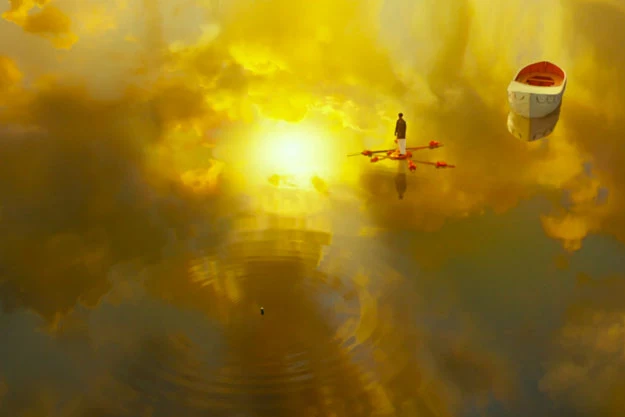
Adrift at sea, Pi witnesses the horrors of the circle of life right there in front of him on the boat. The hyena emerges to attack the zebra. Pi's favorite orangutan, Orange Juice, turns up in the water to join them, only to be attacked by the hyena shortly thereafter. And before long, Richard Parker emerges to assert his dominance over them all, sending Pi scrambling to a makeshift sidecar he's tethered to the boat, created from oars, life jackets and a life preserver.

I don't want to reveal every detail of the plot, but suffice it to say that Pi has to learn to live with Richard Parker and considers along the way a variety of options to deal with him that run the gamut from trying to kill him to trying to train him. The book, no surprise, delves into the psychology behind his options in much better detail.

When Pi and Richard Parker do reach land, it's a deserted island populated by meerkats, where things are not what they seem, and even more difficult to believe. Their stay there is brief, and the two set out to see again, this time by choice, until they meet the shores of Mexico just as both of them appear very close to death.

The novel is divided into three parts, with the second being Pi's time at sea. This middle section accounts for two-thirds of the book's pages. Lee's translation to film is almost identical, and maybe it shouldn't be. As with the novel, Lee focuses on Pi's childhood and his discovery of his unique faith in painstaking detail, postponing the dramatics of the shipwreck for quite some time. The result, to some extent, feels like a movie mash-up between "The Namesake" and "Cast Away."

It is certainly a challenge to keep the audience interested in a film that gives us almost no dialogue for the bulk of its running time, that focuses primarily on one man's survival. Certainly the aforementioned "Cast Away" managed because of the outstanding work done by Tom Hanks in that film's lead role. But Ang Lee chooses a different approach. He relies on visuals.

I suppose I've buried this very important detail late into my review, but it's no less important. As a self-appointed 3-D hater, I can gladly add "Life of Pi" to a very short list of films for which 3-D enhances the experience, as opposed to simply adding gimmickry to it. James Cameron, of course, did so with "Avatar." Last year, Martin Scorsese did it with "Hugo," though of these three films, "Hugo" works the best without 3-D, too, if you ask me.  And now, we can add Ang Lee to a very short list of directors who successfully made a 3-D version of a film truly better than its 2-D counterpart.

The visuals in "Life of Pi" are simply stunning. Breathtaking. The star of the film. But that is so much the case that I think it contributed in the end to my inability to connect as fully to "Life of Pi" as I was hoping to. Because where the novel is a deeply organic spiritual journey, the film is unable to rise above the wonder of its digital accomplishments. The tiger, Richard Parker, is exhibit A. You will be stunned by how life-like he is. Rarely will you find yourself thrown from accepting he is real. But in moments when their surroundings are painted sunrises, glowing ocean surfaces and vibrant greenery, the film reaches a level of beauty that covers up the darkness and torment of the story.

Lee's technical wizardry is almost too ostentatiously displayed, from the way names are revealed in the opening credits to moments when a cut-out of Pi is superimposed in the foreground over a scene on the lifeboat taking place in the background of the screen. I can't say I've seen a movie that looks this stunning in a long, long time. But I'm sad to say that for me, there was something plastic about it.

This brings me back to the alternate story Pi tells at the end. In the book, it's harrowing. Once you figure out what Martel is doing, you are haunted by it. You are equally haunted by the graphic details of animals killing animals and deeply gutted for Pi when he cries out in anguish as he is forced to eschew his vegetarian ways and kill fish and other animals to survive.

Ang Lee goes for the PG version, and in doing so, the film "Life of Pi" has little of the darkness of the book. Yes, we see that Pi lives through hellish conditions. But we don't see any of it. I became most aware of this problem with the film when, in a packed theater, I sat in horror as the audience around me laughed heartily at a scene where Pi is attempting to train Richard Parker. Was there something wrong with the audience? Or did Lee make a serious miscalculation in tone to allow viewers to relax for even a moment at the sight of a 16-year-old, emaciated boy attempting to train a tiger with a sharpened stick?

So in the end, when the writer is asked which version of Pi's story he prefers, the line feels like a bit of a cheap trick in the movie, whereas the novel's darker grounding gave the moment devastating resonance. This moment was never meant to be one of those "you mean to tell me that everything that just happened wasn't real?" moments. "Life of Pi" is not the final episode of "Roseanne." I walked into "Life of Pi" wanting to be moved to tears. That never happened.

"Life of Pi" is too lighthearted about its spirituality. Too PG to be intense. Too beautiful to be terrifying. Too digital to feel organic. And yet, just as Pi Patel's religions contradict each other, so too is Ang Lee's film one that simply should not be missed. And one of the rare films deserving of your extra dollars for a 3-D experience.  And who knows, you might be moved in ways I hoped I'd be.


★ ★ ★

Saturday, November 24, 2012

Rise of the Guardians (2012)

I hate winter.

Now that I've got that out of the way, I can explain why I did not hate "Rise of the Guardians" as much as some of the other critics appear to have hated it. And I think it's because the one thing the film managed to do to me was make me like the most unlikely of characters: Jack Frost.

In an unfortunately predictable script by pedigreed playwright David Lindsay-Abaire (based on the children's books by William Joyce), "Rise of the Guardians" is the essentially the story of how Jack Frost redeems himself, evolving from an ice-throwing prankster with a name not known by children who nonetheless enjoy his handiwork to a full-fledged, Avengers-like hero who has, at the urging of Santa, "found his center."

Santa (called "North" in this film and voiced inexplicably with a Russian accent by Alec Baldwin), is the one who reminds Jack (a compelling Chris Pine) that the work of the legendary Guardians revolves around protecting the goodness of childhood and the spirit of children. He tells Jack that his job as Santa is to maintain a sense of wonder in children. He is joined by Bunny (of the Easter variety, voiced by Hugh Jackman, who is given license to go full-blown Aussie with it), Tooth (of the fairy variety, voiced by Isla Fisher), and Sandy (the sandman, who is both mute and perhaps the most exciting and loveable of all the film's characters).

Jack's problem is that he's all about mischief. In one of the film's moments of true adult-reaching depth, North realizes that although the other Guardians are charged with the protection of children the world over, they are too busy to actually spend time with them. Only Jack, as it turns out, has spent any time near them and with them to observe their natures and behaviors.

But for all of Jack's understanding of kids, he suffers one terrible problem. They don't know his name. And consequently, he is invisible to them. This makes it difficult for the Guardians to understand why the Moon would assign Jack Frost to join them as their newest member.

Jack is forced to figure out his calling quickly, just as the other Guardians are faced with accepting his membership in an instant when Pitch (Black, the boogey man, voiced by Jude Law and drawn quite similarly to Disney's Hades in "Hercules") arrives. Pitch instills fear into the children, turning Sandy's dreams into nightmares and extinguishing the lights on North's globe one by one, the lights that indicate each believing child on the planet. As Pitch replaces beliefs with terror, he vanquishes Sandy's sweet dreams (and Sandy himself) with black dust stallions. He imprisons the Tooth Fairy's "baby teeth," her army of hummingbird-like helpers. And finally, he attempts to forge an alliance with Jack: two under-appreciated forces of nature, neither known fully enough to kids to be able to appear before them.

Despite Lindsey-Abaire's frequent injections of heart and depth, "Rise of the Guardians" defaults to an ending one can see coming from far away, which includes a redemption of Jack that is strangely touching even as it is predictable. The interplay between the other Guardians is mostly annoying. Only Jack is worth following. Fortunately, Jack Frost is central to the plot and the storytelling.

Director Peter Ramsey, a veteran of movie art departments making his feature film debut shepherds crisp, imaginative animation that makes Jack an alluring, Peter Pan-like figure. I could measure the film's success in this endeavor by my son's obsession with Jack Frost since we saw the film. He has spent the last two days searching the house for something he can turn into Frost's staff, used to turn things to ice and temporary collateral damage in the film's penultimate confrontation between Frost and Pitch.

Another problem with "Rise of the Guardians," in addition to the predictable path its story takes and the annoying interplay of most of its main characters, is the speed with which the film flies by. Certainly this is exciting to kids in the audience, but whether it's Santa's sleigh, a kid on a sled at Jack's icy mercy, or swirls of black sand circling the air at Pitch's command, the pace rarely breaths. Even the film's score, composed by the always lovely Alexandre Desplat, surges to uncharacteristic levels of mania. What's sad about all of this is how stunning some of the film's images are, particularly those that involve sand. But the film never pauses enough for us to appreciate or enjoy them.

Ultimately, "Rise of the Guardians" tips gingerly into my "like" column thanks in part to a genuinely affecting back story for Jack Frost, who of course finds "his center" by the end of the film. It's an uneven film of predictable plotting and manic animation with multiple moments of fleeting but resonant emotional depth. I ended up caring nothing for Santa, the Tooth Fairy or the Easter Bunny, though I became an instant fan of Santa's elves, portrayed here as walking triangles. ("They don't really do anything," North admits in one hilarious moment. "We just let everyone think they do." The line goes something to this effect.)

On the way home from the movie theater, my kids asked me a question that pretty much sums up the whole experience. "Daddy, is Jack Frost real?" my son asked. "Is Santa real?" I replied. "Of course," he answered. "Well, then..."

★ ★ 1/2

Argo (2012)

A rare treat of a thriller that excites without the use of special effects, "Argo" embraces the cliche "edge-of-your-seat" and turns it into two hours of film-viewing reality.

The third film in an increasingly-confident directorial portfolio by Oscar-winning screenwriter and popular actor Ben Affleck, "Argo" is funnier than audiences might expect, as wonderfully acted as one could hope for, and more tense than you can imagine. It also boasts a story of more than slight ridiculousness. Implausible, really, if only it weren't true.

On Nov. 4, 1979, the U.S. embassy in Iran is sieged by revolutionaries. Six Americans working at the embassy manage to escape and seek shelter in the Canadian embassy.

Against the backdrop of President Carter's tentative handling of the Iran crisis, in walks Tony Mendez (Affleck), a CIA employee with a track record for rescuing people out of the most precarious of situations. With little time to come up with a plan to rescue the Americans, not to mention decreasing support from the White House and a CIA chief played by Bryan Cranston, Mendez concocts a ridiculous escape plan, one that he couldn't be more serious in proposing.

With the help of Hollywood producer Lester Siegel (Alan Arkin) and a makeup artist named John Chambers (John Goodman), Mendez procures an unproduced film script called "Argo," a science fiction B-grade film. Mendez believes that he could fly into Iran posing as a film producer scouting for desert locations to shoot scenes for "Argo" and, in the process, can reach the Canadian embassy and sneak the self-imprisoned Americans out by training them to assume identities as members of his filming crew.

Naturally, the idea is ridiculous, yet with a little push, Mendez pursues it anyway. He relies on the razzle-dazzle international image of Hollywood to at least temporarily win over skeptical Iranian soldiers he encounters along the way, sometimes even handing them doctored film posters which they accept like prized souvenirs. He makes it to the Canadian embassy and, under the protection of its kindhearted ambassador (Victor Garber), fights with the Americans to convince them that his insane idea is the only way out.

Again, this really happened. "Based on a true story." And one of the best things about "Argo" in a sea of great things is the way Affleck meticulously recreates the time period. Heading into 1980, Affleck populates "Argo" with stock footage of Carter on the television, porn-star mustaches, feathered hair, brown clothes, wide collars and boxy glasses. Almost to a detail, everything looks just as it should be, just as it might have happened. It isn't hard to imagine the film's art direction as first in line when the film awaits its inevitable award nominations this winter.

There's a chance the acting won't be overlooked, either. In fact, it's fantastic from top to bottom. As Mendez, Affleck gives his richest performance in quite some time. Arkin smaller but instrumental role as the film producer could end up getting him his first nomination since winning supporting actor for "Little Miss Sunshine." Goodman, scarily bloated and unhealthy-looking, is dryly funny and calmly wise in a film filled with panic. Garber and Cranston are, each in his own way, riveting. Kyle Chandler is effective as the secretary of defense, and dammit, Chris Messina delivers here in a way that reaffirms that he deserves to be a star.

Aside from the production values and the acting, the most memorable thing about "Argo" is its intensity, and Affleck knows just how to make a heart beat so strongly that it seems ready to leap from one's chest, only to ebb the intensity and then gradually build it minutes later to an eclipsing height. The palpable thrill of watching "Argo" is certainly what every horror film director longs to achieve and rarely manages, and though Affleck frequently overplays the use of extreme close-up shots to signal intensity, he succeeds wildly when it comes to thrills.

If there's a drawback to "Argo" - the slightest hint of imperfection - it comes with the realization that as a director, Affleck does little to demonstrate any calling cards of an authorial style. After his first two films used Boston as a backdrop the way Woody Allen used New York City, Affleck began to carve a signature niche for himself in just two films. "Argo" shares in common with both "Gone Baby Gone" and "The Town" a sense of capturing action and tense suspense in a way that makes it palpable to the audience, and that's a good thing.

But aside from the plentiful satisfaction that "Argo" is expertly handled by a crowd-pleaser of a director, there's little in its style to make someone say: "This is a Ben Affleck film." Those who are not snobby about their films will have no problem with this fact, of course. And someone like me, so excited about Affleck's growing confidence behind the lens with his third-consecutive Oscar-quality film, is now looking for a signature stamp. I wouldn't say it's here, yet. But what is here is enough confidence to indicate that Affleck is starting to figure out just who he is as a director.

If "Argo" is any indication, watching Affleck figure himself out will be our pleasure.

★ ★ ★ 1/2

Saturday, October 13, 2012

Lincoln (2012)

Though I found myself surprised by how affected I was by "War Horse," Steven Spielberg's last live-action film, it received harsh and, in retrospect, justified criticism for playing like a "Spielberg's greatest hits," a movie packed with everything from meticulously-staged and period-accurate battle scenes to twilight silhouettes of a hero against a bright orange sky, all buried under what could be composer John Williams' most emotionally manipulative and dramatically intrusive score. 

So how does the most commercially successful director in the history of film follow that up? With the stunning "Lincoln," a film that on paper would seem like another in a line of obvious Spielberg choices but one that surprises in almost every aspect imaginable. In fact, just about anything you can think of as a classic Spielbergian film maneuver is approached in a fresh and arresting way. It is a talky film from a master of action. A war film that shows little war. A panoramic story that zooms in to such a small amount of time that it is unexpected and even shocking.

Aided by thorough research, fresh approaches to directorial choices and transcendent performances, "Lincoln" belongs in the Spielberg firmament and is easily his best work since "Munich."

I decided not to read much about "Lincoln" before attending an advance screening of the film, so I suspect that one of the things that surprised me most about it won't be a surprise to most audiences once the film is released, particularly not if you are about to read the next few sentences. But I entered the film not knowing specifically what Spielberg's scope would be in terms of storytelling. I figured the movie would only cover his presidency and nothing of his life before that time. I was wrong. It's even more narrow than that.

In what I now consider a stroke of genius, Spielberg zooms in on only one month of Lincoln's presidency - January, 1865 - for two hours of the film's 2:25 running time, its final 20 minutes covering Feb. 1 through to his assassination on April 15. In doing so, "Lincoln" essentially covers only one issue of the Lincoln presidency: the fight to pass the 13th Amendment guaranteeing the freedom of all slaves.

The film's plot reveals a genuine Catch 22 before that phrase existed. Should Lincoln follow through with a potential peace deal with the Confederacy before the amendment to the Constitution goes to a vote, or should the amendment get passed before an end to the war is brokered, even if it means a high number of additional casualties? Does success in one of these endeavors kill prospects in the other if they are executed in the wrong order? In "Lincoln," we watch the president work through this problem, and Spielberg uses Lincoln's decision-making process on this one issue as a microcosm for his entire presidency and, in fact, his very character.

The film's script, filled with elaborately-crafted orations by Pulitzer Prize-winning playwright Tony Kushner, maneuvers between three ongoing snapshots of our 16th president: Lincoln's personal decision making and power brokering, the debate in the House of Representatives over the proposed amendment, and Lincoln's personal relationships with his family.

The scenes in the House chambers, while certainly lacking in physical action, are quite possibly the film's most entertaining moments, and often the most explosive.This has a lot to do with the fiery spirit of abolitionist Thaddeus Stevens, played with such conviction and ferocity by Tommy Lee Jones that he nearly steals the picture from a mind-blowing performance (but one that is muted by comparison) by Daniel Day-Lewis as the president. Jones has such a way with Kushner's sometimes verbose theatricality that you start to miss him when he's off-screen.

In the House chambers, Stevens squares off against Fernando Wood (Lee Pace) and those who are trying to kill the 13th Amendment in the House (which had already passed in the Senate). Meanwhile, Lincoln is shown working with members of his cabinet to devise a plan to win over enough votes. His chief confidante and critic is Secretary of State William Seward (David Strathairn), and he balances Seward's concerns with a request by Francis Preston Blair (Hal Holbrook), a former cabinet member for Andrew Jackson and father of one of Lincoln's cabinet members with a strong opinion about how to end the war.

Some of the film's most powerful scenes are the ones that happen away from its political war games, and they are both economical and effective in helping viewers to understand more about Lincoln, the man. Sally Field plays First Lady Mary Todd Lincoln in that slightly over-the-top Sally Field kind of way, but it works here (it really, really works!) because Mary famously ends up going mad and Field lays that groundwork nicely, referencing the early death of one of their boys. Their oldest, Robert (Joseph Gordon-Levitt in a stoic but relatively thankless role), wants to enlist but his parents cannot bear the thought of losing another son. And some of the film's most touching moments involve quiet exchanges between Lincoln and his youngest, Tad (Gulliver McGrath). I was particularly reminded of the baptism scene in "The Godfather" as Lincoln is seen reading a book with Tad in the White House while the fateful vote is being taken at the Capitol building.


Both Stevens and Lincoln are seen in candid moments where they appear to be compromising their beliefs and values, though these apparent lapses in judgment are truthfully no more than political moves that seem to be necessary to achieve a much larger, noble goal. Lincoln, for example, is a man of the highest moral character in the minds of most of us students of American history, but in "Lincoln" we find him assembling a team of fly-by-night and relatively reckless lobbyists (played with zeal by John Hawkes, Tim Blake Nelson, and a seemingly "True Grit"-inspired turn by James Spader) who are charged with securing the last remaining votes necessary to pass the Amendment, and appear to do so by any means necessary with Lincoln's turn-a-blind-eye permission. Stevens, meanwhile, finds himself needing to strategize his use of words at the potential expense of both his beliefs and his image to achieve a greater good.

Indeed, if "Lincoln" could be boiled down to one word, that word would be "compromise." In a post-screening interview, Spielberg told the audience that he did not intend to make "Lincoln" as a statement on our government's current inability to work across the aisle together, adding that the first draft of this script began in 1999 after he met "Team of Rivals" author Doris Kearns Goodwin and expressed interest in the movie rights to her book. But it's hard to watch "Lincoln" and not see the writing on these otherwise dark walls. Hey, boys and girls, let me tell you a story of a time when men who disagreed figured out how to compromise because it was imperative that they did so. In that sense, "Lincoln" is dripping with irony and in-this-moment relevance and almost makes you more angry about what we're dealing with now.


Spielberg called "Lincoln" his "most performance-based movie ever," and I had to think about that for a minute because I can't think of a film of his without wonderful performances in it. But the success of "Lincoln" lies solely with its actors because with the exception of the film's opening battle sequence, the movie lacks the element of movement that is traditional in mainstream film narrative, and that which is certainly standard in Spielberg films. There is no question that audiences who don't enjoy listening to speeches and relishing acting performances will think less of this movie that I did, but if acting's your thing, I challenge you to find a performance of any consequence to the plot of this film that isn't worthy of an Oscar nomination.

Naturally, the greatest performance of them all is courtesy of Day-Lewis as the president. Of course, it's hard to think of a bad Daniel Day-Lewis performance, but wait until you see this. He is President Lincoln. The transformation is unbelievable, and the names of Spielberg's makeup team might as well be engraved on an Oscar statue right now. But Day-Lewis's physical transformation is as much under his own power as it is the technical team's. He captures Lincoln's poor posture, arms too long and heavy for his frame, and shuffle of a walk. And though the voice he chose is drawing some criticism, I thought it felt right. Based on their research, Spielberg and Day-Lewis choose to avoid what Spielberg refers to as the "Epcot version" of Lincoln, opting instead for a reedy and higher-pitched mid-western tenor. Though we've never heard a recording of Abe's voice, this acting choice simply works.

As I've mentioned a few times, one of the reasons why I am so moved and blown away by "Lincoln" is because here is the work of a director with 26 previous feature-length films to his credit who has a true auteur's style of approaching his craft, and in my mind, if he doesn't abandon it here, he largely dismisses it. He not only preferences talk over action and lasers in on a narrow narrative scope when grand storytelling is his typical approach, but he uses other members of his famous creative team in fresh and effective ways.

Most noticeable to me was the restraint of John Williams' music. It's as if Spielberg is reacting directly here to the criticism surrounding "War Horse," because Williams' work here often lays quite low in the sound mix and is frequently reduced to simple piano work, returning the score to supporting status when perhaps it last had a leading role. It is understated and wholly effective.

So, too, is the dark palate of mastermind cinematographer, the great Janusz Kaminski, who lends to the film's meticulous period authenticity with oil lamp and candle-lit interiors, emphasizing drab blues and browns. Combined with Spielberg's surprisingly claustrophobic and frequently tight shot framing, Kaminski rarely allows the audience a panoramic view of any interior room of the White House. Instead, even as light pours outside its windows, Lincoln is seen huddling over a dim light source in darkened interiors in his attempts to read. Both Spielberg and Kaminski dramatically reduce the grandeur of Washington's most famous buildings, and in doing so intimately put the focus on the men inhabiting them. It is a brilliant move, because only Lincoln himself emerges with that level of grandeur because of it.

I could go on at length about the various decisions Spielberg made, dissecting them and comparing and contrasting them to his earlier works. But I've already gone on too long and said too much, though I promise that I cannot ruin the viewing experience for you, as this is a movie you truly must see for yourself. As a matter of fact, I'm looking forward to watching "Lincoln" again when it hits theatres to see if Spielberg made any last-minute alterations to the cut I saw. I also want to more deeply focus on the film's subtleties, such as the way he uses the black actors in the film, relegated to the wings but constantly a presence, gentle reminders to Lincoln of what he is fighting for.

If "Lincoln" has an agenda, it is one that most audiences will agree with. But Spielberg avoids the sentimentality typically associated with his films and, in his expert hands, navigates the story's inevitable conclusion in an appropriate manner.

I have spent days now thinking about how "Lincoln" appears on the surface to be a classic Spielberg project. It's one of his "histories." (Like Shakespeare, Spielberg works can be divided into categories, sharing histories and adding action/thrillers and science fiction/fantasy as his other major genres.) It is as well-researched and authentic as any historical film he's ever made, down to the details of portraying the president as a perpetual storyteller, sometimes even attempting a laugh or garnering the impatience of his audience. But in so many more ways, I'm constantly reminded of how "Lincoln" is different from a typical Spielberg film. And for a director more than 40 years in to film making, my stove pipe hat is off to him.


★ ★ ★ ★

Friday, October 12, 2012

Hotel Transylvania (2012)

Almost without exception, I would consider Adam Sandler to be the life force that can suck the joy and competence out of any film he touches, a sad reality when you consider how genuinely funny he could be in his sketch comedy days on "Saturday Night Live." But I never thought that would extend to movies that just contain Sandler's voice.

Alas, his voice and his behind-the-scenes work as producer are enough to throw the animated "Hotel Transylvania" directly into the cinematic circular file. Co-written by "SNL" collaborator Robert Smigel and directed by TV animation veteran Genndy Tartakovsy, "Hotel Transylvania" takes a fairly clever idea and a far better than average vocal cast and generates 90 minutes of spastic movement swirling around recycled ideas.

To put it another way, I found the film so unmemorable that I struggle now to recap it for you. But I'll take a shot at it...

Dracula (Sandler) is left to raise his daughter Mavis (Selena Gomez, a Disney star swap-out for the originally cast Miley Cryus) alone after the death of his wife at the hands of humans. Vowing to protect Mavis, he has a giant castle of a hotel built in Transylvania where monsters and creatures of every type and variety will be welcomed in their travels and feel safe from human interaction and danger.

Mavis, in a storyline highly derivative of everything from Rapunzel to this summer's "Brave," wishes to see some of the world and whenever her birthday comes around, her hopes are repeatedly crushed by her father. That is until her 118th birthday, when Dracula relents. But unbeknownst to Mavis, her first experience in the human world is nothing more than a hoax, elaborately staged by her father with the help of local zombies (playing humans, naturally) to guarantee that she will no longer desire to leave the hotel.

This plan seems to work until the inevitable human infiltrates the many barriers set up to keep him away from the castle. Dracula is immediately aware that the jam band-loving, slacker-y Jonathan (Andy Samberg) is in fact a human, and explodes into panic as he attempts to remove Jonathan from the hotel, or at least disguise him from the other monsters. But in a plot twist I doubt anyone wouldn't see coming, Jonathan bumps into Mavis and the two are, like, waaay into each other, man.

Thus a father must come to terms with his daughter loving a being of another species and his Marlon-in-"Finding Nemo"-like obsessiveness with controlling his child's every move. And one human is able to cause the slightest nudge in the monsters' perception of humans as creature-killer-terrorists.

The fact that "Hotel Transylvania" is little more than a half dozen preexisting animated film story plots (all originally told better) dressed up in Halloween costumes is simply unavoidable. While it certainly matters little to kids, there is not a single new idea or message in this film once you get beyond its morose and actually quite dramatic and interesting premise. Indeed, the film's few decent moments are explorations of Dracula's great loss and fears of suffering further loss. And a touching late-act scene in which Dracula and a few of his comrades realize just how accepted they can be in the human world has real-world resonance that is highly current. Sadly, these moments of promise are as fleeting as a ghost through one of the hotel's hallways.

Classic Universal horror film characters such as the Frankenstein monster, Mummy and Werewolf appear here in mutated forms in supporting roles energetically voiced by Kevin James, CeeLo Green and Steve Buscemi respectively, and they keep kids entertained with their antics. Joining them are a host of "SNL" alums from Jon Lovitz to Molly Shannon. But with nothing fresh to work with in terms of material, there is little pleasure in hearing what their voices can do.

In addition, the animation itself is lackluster. Earlier this year, I strongly disliked the big screen version of "Dr. Seuss' The Lorax," but at least while doing so, I was delighted by the vivid colors and wonderful animation. "Hotel Transylvania" was unable to satisfy me even on this level. For a film so long in development, how could Sony's animation division put out something so uninspired, so visibly rudimentary and rushed?

My kids really enjoyed "Hotel Transylvania," and I bear no ill will toward anyone of their age who has a blast watching a monster movie in such a unique position to take the abject terror out of some of film's most notoriously scary monsters; even the child of weakest wills can laugh free of fear in this picture. But no one over elementary school age has any excuse to enjoy "Hotel Transylvania." That is, unless they've never seen another animated film before.

Ultimately, I did find myself in alignment with "Hotel Transylvania" on one issue, a thought that came to me about a third of the way in and never left me. Just like any human trapped in a monster hotel would say, I found myself whispering: "Get me out of here!"

0.5 out of 4


Saturday, August 18, 2012

The Campaign (2012)

For the first time in my life, I drove to a movie theatre and laid down money to see a film starring Will Ferrell. Having been a huge fan of his work on "Saturday Night Live," it's been my disappointed belief ever since that Ferrell's genius is limited to bursts of no more than 10 minutes, some sort of Faustian bargain to make him the funniest guy on the planet in exchange for the brevity of wit that would forever curse him to never carry a film.

Believe me, I tried to laugh at Farrell's movies, though I never trusted him - or them - enough to see them in the theatres. I decided that when Farrell is not the focus, such as in "Old School," his film work seems to stand up better. And as a news and media guy, I've wondered again and again why the beloved "Anchorman" is so not funny to me.

So I don't know what possessed me to want to take a chance on "The Campaign," but I did. And either I was exhausted when I saw it or just genuinely open to it, because I really enjoyed it. Like a lot. Like more than I'd like to admit. Co-starring the also funny-quirky Zach Galifianakis,"The Campaign" is a sly satire on the absurdity of the political campaign season in America.

Ferrell plays congressman Cam Brady, a smug political asshole preparing to run unopposed for reelection to his North Carolina seat, who is shockingly and suddenly challenged for it by a pouf of a man named Marty Huggins, a doughy, unimposing family man who's backed by a super pac with dubious capitalist and corporate interests to take the seat. Huggins, of course, is genuinely interested in helping his community and is unaware of the source of his growing power to challenge Brady.

The campaign season becomes a game of one absurd one-upsmanship, with Brady subjecting Huggins to sleazy acts of embarrassment and Huggins learning to dig back thanks to the the arrival of Dylan McDermott as a macho mercenary of a campaign manager, who begins his work by first replacing everything in Huggins' home to improve his image, even going so far as to exchange the two family pugs for golden labs, which test market better with voters.

The personal attacks on each other go to such great and childish lengths that I wouldn't dare spoil them for you by listing them here, because the fun of watching "The Campaign" is knowing that each act of retaliation will only be more ridiculous than the last and waiting to see what specifically we will get.

The film has a supporting cast that isn't being advertised enough in the shadow of its two huge lead stars, but support work by McDermott, Jason Sudeikis (as Brady's campaign manager),and Dan Ackroyd and John Lithgow (as scheming and dubious revenue sources to the Huggins campaign) are just additional reasons why this particular film holds up a little better than Ferrell movies in the past.

I've read more negative reviews of "The Campaign" than positive, and what I've found interesting is that most of the negative reviews express disappointment over the fact that the film had the opportunity to be a sharp satire on American politics but wasn't. They propose that to see it as such is to be creating subtext that director Jay Roach never truly put there. What movie were they watching?

Take it from me: that satire is there, and perhaps the reason I liked "The Campaign" is because it's one of the only times I can think of when Ferrell's on-screen insanity has been grounded by something truly topical. His eccentric characters are always to be laughed at because they are so out there. But you can't watch this film without nodding your head with the familiarity that Cam Bradys exist right now, everywhere, all over America. They are perfectly-coiffed, handsome, hollow shells of men being filled by ideas by those who put up the dollars to fund their campaigns. And only the insane level of farce that this film goes to can achieve a sense of comedy when, in reality, lesser versions of the same games are actually being played out there, and they are not funny at all.

Entertainment Weekly critic Owen Gleiberman is wise to point out, I think, that director Jay Roach is not one of Ferrel's traditional collaborators and that Roach has previously directed the political HBO films "Recount" and "Game Change." So although this is also the man who brought us Austin Powers, he knows what he's doing when it comes to exploring the American political landscape in terms of the aspects of it that make us scratch our heads.

By the time "The Campaign" is over, we reinforce the idea that some of our elections are choices between bad and worse, and Roach ultimately calls voters on the carpet, too, for the decisions they ultimately make. And for me, the stroke of genius to lay a foundation of truly relevant and grounded social satire underneath Ferrell's largely unaltered buffoonery was enough to make me say that I paid for a Ferrell movie...and I liked it!

3.0 out of 4

Friday, August 3, 2012

Ted (2012)

Since my formative years occurred during the 1980s, I've got some fairly romanticized memories of that decade. The older I get, in fact, the more I think the 80s was the greatest decade, like ever. This, of course, cannot possibly be true, but it's my reality. Nor could it be true that that a slightly-altered version of one of that decade's greatest toys, Teddy Ruxpin, could carry a modern-era, feature-length film. Here, I'm more realistic; it can't. Not even in the hands of the one guy who could actually pull it off, fellow 80s-lover, Seth MacFarlane. His teddy-bear-comes-to-life tale, "Ted," is a great idea with some outrageously funny moments, but it's difficult not to watch and wonder why the film wasn't more clever still. "Ted" is all empty calories: you laugh and laugh and then in between jokes wonder why the movie is so lame.

The big let-down in "Ted" is not the humor, which is as outrageously politically incorrect as one would expect from the creator of "Family Guy." Instead, it's the plot, which is so pedestrian that any remotely alert viewer who has ever seen anything will figure it out rather quickly and be completely accurate with the prediction. "Ted" tells the story of a loner boy named John who receives a huge teddy bear for Christmas one year as a boy and makes a wish that the bear, which he names Ted (of course), will be his friend forever. The bear comes to life to accept this agreement.

The one funny plot hook of the film - its one clever conceit - is the exploration of what would happen later in life when that boy is now a man. What happens to the bear? "Ted" flashes forward to show us a now 35-year-old John (Mark Wahlberg), who is barely what you could call a man, but still doing almost everything with Ted (voiced by MacFarlane in a vocal performance sometimes too similar to his Peter Griffin). After all, how do you just box up, donate, or otherwise get rid of a teddy bear who's come to life?

And why would you want to? Ted is a hard-core party animal: a sex-crazed, beer-guzzling bear who scores the best pot in the neighborhood, makes jokes about 9/11, and calls fat kids "Susan Boyle." He's always been the life of John's party, and John's party has always revolved around Ted. So when John, the biggest film case of arrested development I've seen in years (and there are tons of films with these kinds of characters around right now) tries to navigate his romance with Lori (Mila Kunis) with Ted looking on, well, it's clear that the film is headed for a very stereotypical "it's either me or him" ultimatum on the part of the girl who has waited four years for a marriage proposal, and for her man to grow up. I can stop summarizing the plot here, because you already know that John will make her promises and that Ted will interfere and screw them up. John will be forced to choose between the two and will choose the girl, and then a dejected best friend will cut off communication with him for a while but ultimately the friends will be reunited by some sort of conflict that will end with the three of them happily, if inexplicably, accepting each other.

Couldn't the brilliant writer of "Family Guy" come up with something better than this? Film critic Brad Brevet, who disliked "Ted" much more than I did, makes a fantastic point when he reminds us that MacFarlane, on his TV show, "has a knack for pointing out the weaknesses in films and television shows and yet when it comes to creating a film of his very own he decides on the most cliched storytelling available to him." I couldn't summarize the problem with "Ted" better, so I won't try to. The film feels like a cheap excuse to string some jokes together, a scenario rather than a plot. And that's a big disappointment.

What I found far less disappointing, however, was the humor in "Ted," unapologetic in its pervasive use of crude, offensive and culture-skewering humor. Maybe it's because I am only three months older than MacFarlane that I share much of his sense of sarcasm and taste for what's funny. So a scene featuring actor Giovanni Ribisi dancing in front of a TV to a Tiffany music video, for instance, is as funny to me as it is to him. And MacFarlane's rapid-fire use of pop culture references, some of which might be obscure to teenaged fans of "Family Guy," are firmly within my wheelhouse and memory bank of childhood, meaning that they strike me right at the funny bone in an instant, with no need for further context clues.

The dialogue exchanges between John and Ted give the film its best moments. In one particularly funny conversation, Ted tells John that he's met a girl with a "white trash name" and they turn it into a game, John running through over two dozen names without taking a breath. What's even funnier is that most of the names are relatively common, thus meaning that MacFarlane is calling many of "Ted"'s female audience members "white trash" by proxy. Not that much of "Ted"'s audience is female; "Ted" joins "The Dark Knight Rises" as an oasis for movie-going men in the summer of "Magic Mike."

I laughed so hard at "Ted" that I think I'd eventually need to see it again to get some of the jokes I missed. In fact, while reviewing some of the great quotes from the film on IMDB, I saw at least three that I didn't even remember. No doubt I was in the middle of punching my best friend's arm in the movie theatre or stabilizing my rolling office chair in the upscale eatery-theatre to prevent my friend from shoving me down the aisle flight of stairs in a fit of laughter. Ultimately, "Ted" is not only about a man who won't grow up enough to not need his teddy bear, but a man who won't grow up enough to work his way beyond ironic, childhood pop culture humor. And while I can't relate to the film's pervasive use of drug humor, I can certainly relate to that.

2.5 out of 4