20. LETTERS FROM IWO JIMA, Clint Eastwood (2006). The first entry of two on my list from my favorite director of this decade. Eastwood is criticized for being too simple and non-experimental with his direction, but notice how much more emotionally potent his films are as a result. Here, as a companion to "Flags of Our Fathers," Eastwood focuses on the Japanese soldiers and makes the Americans the faceless enemies instead. And it's the furthest thing from "un-American." Rather, it's a powerful anti-war film that reminds us that the enemy is the other side, no matter what side we're on. And we all think we're right. And we all defend our truth. And it sucks every time. A dingy, grey, fantastically acted Eastwood masterpiece.
19. MINORITY REPORT, Steven Spielberg (2002). Spielberg also shows up twice in my top 20, doing his strongest work in the first half of this decade. This isn't just a popcorn sci-fi flick. It is a philosophy film that explores free will vs. determinism, building on classic stories like Fahrenheit 451, 1984 and Brave New World. It's a rare film that not only looks the way the standard Hollywood action film should look, but has something important to say as well. Easily one of the best "mainstream" films of the decade.
18. LORD OF THE RINGS: RETURN OF THE KING, Peter Jackson (2003). Just as with Star Wars, everyone has their favorite LOTR film. I lean toward the last one, not because it was the one that finally won all of the awards (likely on behalf of the whole trilogy), but because the relationship between Frodo and Sam was at its most emotionally powerful here. Jackson also perfected Gollum, introduced in "The Two Towers," and Andy Serkis should have been the first actor nominated for a motion capture performance. James Cameron said that seeing Gollum is what made him decide to move forward with "Avatar," so attention must be paid. Exciting on all levels, this one also moved me to tears.
17. MEMENTO, Christopher Nolan (2001). I'm not sure if many directors had a better decade than Nolan, but the projects handed to him (such as the recent Batman films), were based on this piece of mind candy, a product of genius editing and twisted storytelling. At it's core, it's a standard revenge film. But its delivery is anything but standard. If nothing else, it forced others to reconsider what the narrative structure of a film looks like. Nolan is not the first to mess with story structure like this, but this offering was one of the most memorable examples of the decade, focusing on a guy who's bad memory forces the film's ingenious backward and looped conceits.
16. INGLORIOUS BASTERDS, Quentin Tarantino (2009). Speaking of loopy, unconventional narrative structures. Time will tell, but I think this is Tarantino's masterwork. He actually ditches the sidebars and time warps and puts his demented spin on what would have been the ultimate revenge story in 20th Century world history by imagining that a powerful collective of renegade Jews could get to and take care of Hitler. Everything Tarantino is known for is in here, and perfected here. A 30-minute scene in a tavern is one of the most watchable single scenes of the decade, let alone this year. I am not a Tarantino-head, so I thought long and hard about where to put this one. I stand behind my choice. It's this good.
15. IN THE BEDROOM, Todd Field (2001). Field made two stunning suburban dramas this decade. The other was "Little Children." But this one felt like it almost started one of my favorite trends of the decade: the low-budget, acting-focused and writer-centric suburban stories that always ended up at the top of my year-end lists. Sissy Spacek, Tom Wilkinson and Marissa Tomei are stunners here, in an adaptation of an Andre Dubus story that is filled with realism and family terror. I couldn't get this one out of my head. Still can't. And there have been many films like it since.
14. CROUCHING TIGER, HIDDEN DRAGON, Ang Lee (2000). Talk about a movie that really changed the game. It broke box office records for a foreign film at the time and grabbed a Best Picture nomination, something that doesn't happen often for a non-English movie. Even more outrageous to me was how this film about ideas and locations that I'm rarely drawn to so completely captured my attention and imagination. I was never opposed to watching foreign language films, but after this one, I started running to them. Gorgeous art direction, magical action and strong acting. Worth another look.
13. MATCH POINT, Woody Allen (2005). As a Woody Allen fanatic, it's admittedly become increasingly difficult to look forward to the annual Allen offering because the results have been less consistent in the 2000s, and the critical favor has waned. But mid-decade, Allen made his first fresh choices in many years. He decided to leave New York City. He also decided to abandon self-referential comedy. Both choices worked, brilliantly. "Match Point" is not only his best film of the decade, it is worthy of a spot in the top tier of his films, period. A Hitchcockian tale with cinematic poetry and symbolism and sexy, magnetic performances by Jonathan Rhys Meyers and Allen's muse of the decade, Scarlett Johansson. Nothing felt better than knowing that the Woodman still had it.
12. CRASH, Paul Haggis (2005). It's become trendy to "Crash-bash." But I'm not having it. Everyone who now groans that the converging storylines are too coincidental and not plausible is missing the point. This film captured post-9/11 racial anxiety in a way that no other film has, and its admittedly too-tidy script is really meant to be a collection of character essays, not a believable narrative. Haggis, a darling in the film world in the 2000s, got the best acting to date from just about every actor in his cast, and it's time to stop hating it as the David that toppled the Brokeback Goliath at the Oscars. From a pure emotional standpoint, this film is loaded with poignant and teachable moments when most movies could only hope for one or two. As a father, the scene when Daniel's daughter runs out of the house to give her dad the "invisibility cloak" still causes me to projectile sob. As a film teacher, I rarely have conversations with students as meaningful as the ones I have after we watch this.
11. ROGER DODGER, Dylan Kidd (2002). The most obscure choice on my list, I actually had it as high as #5 before reconsidering. I love it that much. Playing with the guys-in-charge style of storytelling ushered in by Neil Labute's "In the Company of Men," "Roger Dodger" is an unforgivingly macho film that introduced the talent of Jesse Eisenberg and gave the underestimated Campbell Scott his best character, ever. The story is base, about a slick, smooth-talking ladies man who allows his nephew to tag along for a night out on the town to learn about sex from a master. But the dialogue is as crisp as anything Tarantino has written. And the film is deliciously re-watchable. A personal favorite of the decade, though admittedly the film is cruel, crude and decidedly anti-female (or maybe just pro-male).
Thursday, December 31, 2009

Star Trek (2009)
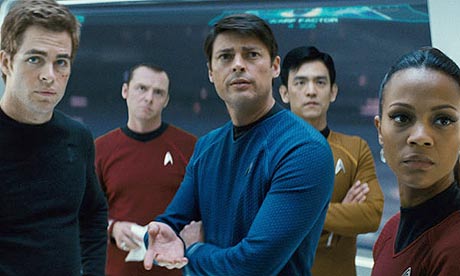
STAR TREK's two hours fly by, and unlike most complex science fiction stories, the audience here is always in-the-know, whether you came to the film as a long-time follower of the series and films or this was your first Trek experience.
I am somewhere in the middle: not a Trekkie, but someone who has seen most of the films and has a basic sense of historic plotlines and relationships. My memory does not have enough of the finer details of the story stored, however, and I was concerned that watching a reboot of the story, as director J.J. Abrams employs here, would be confusing to me.
My worries were unfounded. STAR TREK is so cleverly-written that an amateur can follow it and an expert can agree with it. Even more clever is the casting; every significant character is instantly identifyable here. With those worries out of the way, one can simply sit back (if you're able) and enjoy a summer popcorn flick the way it was meant to be done.
George Kirk, a brave Federation captain, sacrifices himself to save hundreds of members aboard the ship that was just placed in his control, including his wife, in labor with their son. This son, James, grows up in Iowa and is a hell-raiser, but is eventually convinced to attend the Starfleet academy and fulfill the promise shown by his father. Jim is a cocky ladies' man and struggles in the academy because he dislikes rules and authority figures. His strongest dislike is for Spock, a young lieutenant in the Starfleet and outcast among his Vulcan people for having a human mother.
The new Kirk and Spock are played by Chris Pine and Zachary Quinto. Pine is an inspired choice, with the gravitas for the role and the lightness for its humor. Quinto, by comparison, seems like the only logical choice (pardon the Trek joke), as he's been drawing physical comparisons to Leonard Nimoy since he began his work on NBC's "Heroes." Both are excellent here.
When an emergency on Vulcan causes the Starfleet to christen its new USS Enterprise, Spock takes off for space joined by other familiars like Uhura (Zoe Saldana), Sulu (John Cho) and Bones (Karl Urban). The recently-punished Kirk finds a way onboard as well, though he is eventually discovered and cast off the ship, picking up Scotty (Simon Pegg) along the way and bumping into...Spock? It's well-known by now that Leonard Nimoy appears in this STAR TREK, too. I won't spoil it for anyone who hasn't seen the film yet, but the way Abrams works him in is quite clever, and not as difficult to follow as one might expect.
The special effects and production values of STAR TREK are as good as you'd expect them to be, and maybe it's due to Abrams' ability to build on such a known pop culture myth that this film flies by twice as fast as James Cameron's "Avatar." Perhaps, at least subconciously, we all walk into this one knowing more than we think we know. This is assisted by a script that includes one clear mission for the crew that is motivated and justified, and plenty of minor winks and nods to appease longtime fans. Without those references, STAR TREK might feel like "Star Trek for Dummies," but it doesn't. And yet this film appealed to my 8-year old daughter as much as it did to me. She sat down and watched the entire film and loved it, too.
For big budget entertainment, I can't complain about STAR TREK. It's the kind of film I would buy on DVD and pull out repeatedly to enjoy. For what it set out to do, I think it did so successfully. It was fast-paced, and it was fun.
3.5 out of 4
Wednesday, December 30, 2009
The Top 40 Films of the 2000s: 30-21
30. MARIA FULL OF GRACE, Joshua Marsten (2004). Those who swear off foreign films are missing movies like this. Catalina Sandino Moreno was Oscar-nominated for her portrayal of a pregnant Columbian teenager who takes a job as a drug mule to get to the U.S. One of the most terrifying films of the decade, filled with sadness, intensity and suspense.
29. A HISTORY OF VIOLENCE, David Cronenberg (2005). Cronenberg and the fantastic Viggo Mortensen made two stunners this decade, but this one gets the slight edge over the more showy "Eastern Promises." It's a captivating look at how violence can affect an individual and a family that grows richer with repeated viewings.
28. BROKEBACK MOUNTAIN, Ang Lee (2005). Now often the butt of jokes, the cultural impact of this film cannot be denied. Slightly-long, a little slow, and deeply effective on a profound, emotional level. A revelatory love story of its time, whether you allowed yourself to be comfortable with it or not.
27. NO COUNTRY FOR OLD MEN, Joel & Ethan Coen (2007). Like my pick before this one, here's a film that took conventions of the Western and spun and updated them. Cormac McCarthy, an excellent writer, is the basis for Hitchcockian suspense and terror in the hands of an unforgettable Javier Bardem performance and the Coen brothers, who almost made my list two other times (with "The Man Who Wasn't There" and "O Brother, Where Art Thou?").
26. UNITED 93, Paul Greengrass (2006). Waiting just long enough for America to be able to face the domestic tragedy of the decade on a movie screen, the electric Greengrass (a whiz with his Bourne films) casts a bunch of no-names and directs the hell out of this portrait of the hijacked plane that ended up in a field in Pennsylvania. Not one to watch multiple times because it's that hard to watch. But it's not like you'd forget it, anyway.
25. MAN ON WIRE, James Marsh (2008). The best tribute to the now-gone World Trade Center was this gorgeous, Oscar-winning documentary, my favorite of the decade. Recreating the plan to get French tightrope walker Philippe Petit to the top of the twin towers in the early 1970s, the film gracefully fails to acknowledge that the towers are now gone and, instead, highlights the passion of pursuing one's art to the rhythm of a fast-paced action/heist film.
24. ETERNAL SUNSHINE OF THE SPOTLESS MIND, Michel Gondry (2004). With an imaginative narrative structure that helps to tell the story, this film cemented Jim Carrey's status as an actor to be taken seriously and is but one example of the power of Kate Winslet, perhaps my favorite actress of the decade.
23. MOULIN ROUGE!, Baz Luhrmann (2001). Though not necessarily my favorite musical of the decade, this film (to a greater extent than "Dancer in the Dark") deserves credit for reigniting the musical as a viable commercial art form in cinema once again. A dazzling specatcle, Luhrmann closed his red curtain trilogy with fabulous art direction, cinematography, costumes and lighting, and ushered in the era of serious actors trying their hand at a tune that Woody Allen poked at a few years prior with "Everyone Says I Love You." All shamltz and melodramatic goodness.
22. BEFORE SUNSET, Richard Linklater (2004). A gorgeous, quiet film reuniting Ethan Hawke and Julia Delpy nine years after they first fell in love in "Before Sunrise." My favorite romance film of the decade, it's an 80-minute film about four hours out of the lives of two one-time lovers who, inexplicably, are able to see each other one more time.
21. Y TU MAMA TAMBIEN, Alfonso Cuaron (2001). A fantastic coming-of-age film, albeit one filled with graphic sex, and a hard-to-forget male fantasy film as two teenage boys in Mexico embark on a road trip with a sexy, older woman. Caliente!
The Messenger (2009)

If a film can affect me on an honest, emotional level, I am considerably less interested in any flaws it might have. Quite often, especially with smaller films, I am a writing and acting first, stylish direction second kind of guy. THE MESSENGER is this kind of film. It lacks artistic directorial elements and could use tightening in spots. But it is also one of the best acted films I've seen this year, and one of the most emotionally powerful.
Why Ben Foster's name isn't more firmly in the conversation for the Best Actor race is beyond me. There are many films from 2009 that I have yet to see, but of those I've seen thus far, his is my favorite male lead acting performance. Woody Harrelson does seem to be getting buzz for his supporting performance in the film, and Amy Morton continues to be one of my favorite actresses for her work here. All three deserve Oscar nominations. So does the screenplay. But I digress.
Foster plays Army Staff Sgt. Will Montgomery, an Iraq War vet assigned to complete the final three months of his tour on "bereavement notification" duty. Simply put, he's the guy who shows up at your door if your loved one has been killed in combat. He's the one you don't want to see, the grim reaper in a pressed military uniform.
Montgomery is not happy about this detail, not after having seen real combat. But this is how he will play out his time in the Army, at least for now. He was wounded in Iraq and declared a hero. But his eye and leg injuries seem to be less of an impairment than what is most likely post-traumatic stress disorder. And now, he must spend his days delivering that trauma to civilians.
To make matters worse for Montgomery, he is to follow a strict script. This is protocol, and protocol is enforced by Captain Tony Stone (Harrelson), a recovering alcoholic who served two tours during the early 90s conflicts under the first President Bush. Never having seen any actual combat, Stone is even more stiff and militaristic than Montgomery. Apparently, he has spent a good deal of time on bereavement notification duty and has to remind himself and others that he is still a soldier.
Sticking to the script means not showing any human emotion toward the "NOK" (next of kin) the soldiers encounter. The memorized script includes a statement of empathy: "I'm sorry for your tragic loss," or something to that effect. But Montgomery is cautioned not to touch or hug. Get in and get out. Stone is good at this, but Montgomery is not. It's clear that he wishes the job could be completed with a little more compassion than that.
Both Montgomery and Stone are ticking time bombs. The audience waits to see how long it will be before Montgomery cannot complete his job assignment was assigned, and there is also the expectation that Stone is all artifice, a breath away from another alcoholic beverage and a genuine mess under the surface. Indeed, both of these things come to pass.
How would you respond if men like Montgomery and Stone came to your door? THE MESSENGER explores a believable range of reactions. Some simply won't believe the news. Others get angry. Steve Buscemi is believable to his core as an angry father who spits on the men and calls them cowards. Why aren't you over there dying? He demands an answer. Samantha Morton's newly-widowed Olivia poses an even more stunning, though subtle response. Thank you, she says, shaking their hands. It must be hard for you to deliver this kind of news.
For reasons unexplained (as they should be), Montgomery feels a connection to Olivia and her son. He begins to defy orders and pops up in her life to check up on her and help her with odd jobs. He half-hides behind a tree at her husband's burial. What is clear is that starting something with her would be inappropriate, but it is hard for him to help it. These scenes are played with amazing depth and quiet by Foster and Morton. Foster, in particular, is a revelation. All of his macho, bad-ass bravado displayed in films such as "3:10 to Yuma" are stripped away here. The guy who typically demands attention by mouthing off is all but completely silent. In one of his best scenes, he says nothing. Morton talks at her kitchen counter, stealing sips of coffee. Foster listens, struggling to know what to do with his hands, calculating the personal space between them.
Eventually, Montgomery's need to be compassionate spills over into his treatment of other families when delivering news and, before the film is over, even Stone is made to cave. Scenes played between Foster and Harrelson when the men are out of uniform are significant: two men who are the same but so different, trying to bond. Harrelson, who is always good, gets the transformation down here. His character takes a true journey in this film, changes to his core from beginning to end. A man who shows only strength and control at the start is a humbled, flawed survivor at the end. His control over Montgomery evolves into awe and respect for him.
If the film has a flaw, it's that first-time director Owen Moverman, who also co-wrote the script, has a bit of trouble keeping everything tied together at the end, and the film almost starts to devolve into a buddy picture before it ends on a beautiful, true note. His direction is generic, and maybe that's just as well. The star here is the script, and no flourishes distract from that. And, as I've said a million times, if you've got the right actors, you can cover up those weaknesses.
I did not feel emotionally manipulated by THE MESSENGER. Just genuinely moved. Each scene involving a family receiving notification about their lost loved one broke my heart anew. Nothing ever felt forced or melodramatic. Is this the war film of the year? No, simply because "The Hurt Locker" had the strong direction to match a great script and acting. But it's tough to even compare that film with THE MESSENGER, a film that is more of a chamber piece about the sad humanity of those of us left in America, slowly being divided into the two camps of those of us who have been affected by this war and those of us who have not.
No one should ever have to understand what it feels like to get that knock on the door, but THE MESSENGER brings needed understanding and empathy to that feeling. It is a fantastic film.
3.5 out of 4
Tuesday, December 29, 2009
The Top 40 Films of the 2000s: 40-31
40. DANCER IN THE DARK, Lars von Trier (2000). An emotional gut-punch as strong as any this decade.
39. THE 40 YEAR OLD VIRGIN, Judd Apatow (2005). The best sophomoric comedy for adults this decade.
38. BRICK, Rian Johnson (2005). Classic film noir gets a reboot in a high school. Moody goodness.
37. CAPTURING THE FRIEDMANS, Andrew Jacecki (2003). In this era of people trying to get on camera and documenting themselves for no good reason, it's downright creepy that this family happened to be filming its own implosion for years without even knowing it.
36. ZODIAC, David Fincher (2007). One of the classic true crime stories of the past century gets a tense, brilliant second look.
35. TRAFFIC, Steven Soderberg (2000). Revitalized the Robert Altman style of converging character arc storytelling and introduced us to the now-trendy "small world" concept of global exploration seen in dozens of films this decade, from "Syriana" to "Babel." Other directors like Inarritu would succeed with this style in the 2000s, but Soderberg invented it.
34. SIDEWAYS, Alexander Payne (2004). If "40 Year Old Virgin" was the best sophomoric comedy for adults this decade, this was the best sophisticated one. Perfect acting performances, to boot.
33. MULHOLLAND DRIVE, David Lynch (2001). I still don't get it, but I love trying. Admittedly, this is a "snobby" pick made with my head and not my heart. Maybe I feel obligated to include it, but it is one of the best films of a very important filmmaker.
32. ONCE, John Carney (2008). The scene in the film that introduces the Oscar-winning "Falling Slowly" is one of the most romantic scenes of the decade, and the lovers don't even kiss. A film that was truly able to harnass the power of music.
31. IN BRUGES, Martin McDonagh (2008). Fantastic lead acting performances and whip-smart direction from the Irish Tarantino. Few movies this decade had me laughing this hard.
The top 40 films of the 2000s: A Preview
Well, it's taken me a solid month to make this list, not to mention some rewatching of films, coaxing from friends, and self-debate and doubt. Even as I completed the list of 40, I stared at a list I had sitting off to the side of films from the decade that would probably be on the list if I had seen them already. At first I wanted to be embarassed by the fact that I haven't seen some of these films that are appearing on the best-of lists of many critics. But then I though, you know what? They are getting paid for this, and although I SHOULD be, I am not. I have taste. I will get around to them. This list can only be about what I have seen, not what I should see. And these lists are transient. I can change my mind tomorrow.
The list I came up with is actually fairly well-distributed across the decade. Three films each are from 2000 and 2003, 4 films each from 2002, 2006 and 2008, 5 are from 2004, 6 are from 2001 and 2005 respectively, and the year 2007 leads my list with seven films. In addition, one film from this year, 2009, makes my list (and does quite well on it). I suspect that if more time had gone by and I would have had time to see more from 2009, a few more titles might have snuck in, but at least all years from the decade are represented here.
Choosing films for a list like this is very difficult. I tried to use the following criteria as my guide:
1. CULTURAL SIGNIFICANCE. If the film was responsible for a style or trend or captured the mood or attitude of the decade, it merited consideration here.
2. RE-WATCHABILITY. Some films on the list are powerful in ways that make them difficult to watch multiple times. Sometimes, once is even enough. But most films on the list are movies that grow more rich with repeat views.
3. MASTERY. I tried to pick films that came close, in my opinion, to being the best the could be, given what they were trying to accomplish. It is very difficult to measure something like "The Dark Knight" against something like "The Lives of Others." So you have to ask yourself how successful the film was in doing what it was trying to do. Still tricky, but at least it gives you a guideline.
4. EMOTIONAL CONNECTION. Ultimately, this helped me order the films once the 40 were picked. You might see things up higher that had a stronger emotional impact on me, and films that my brain tells me were masterful or important will appear on the list, but lower. Go with your gut, they say. In fact, my #1 had to be the movie that moved me the most.
Next, the list!
The 10 Most Overrated Films of the 2000s
Note: This is a slightly-edited version of a post I made on Facebook on November 28 as I was beginning to draw a list together to make my top 40 films of the 2000s. That list will follow soon!
Here's my list of the most overrated movies of the last ten years. These are films that did very well with critics and/or audiences, but not with me.
HONORABLE MENTIONS, or "lifetime memberships":
* The films of Michael Moore:
Not too many filmmakers had as successful a decade as documnetarian Michael Moore, but to me, he's the left's answer to Rush Limbaugh: a blowhard with a movie camera instead of a radio show. "Bowling For Columbine," "Fahrenheit 9/11," "Sicko" and "Capitalism: A Love Story" (the last of which I have not seen) capture the far-left zeitgeist with the otherwise-talented Moore's trademarks of emotional manipulation, egregious fact omission and self-promotion. Moore is the only guy making documentaries who has to star in his own films, and my favorite of his films will be the one when he resists the urge. There are rumors that Moore is done with documentaries. That'd be great. There were some amazing documentaries made this decade, and while his were always among the most provocative, they were not the best.
* The films of Will Ferrell:
"Old School" worked because Ferrell wasn't the main focus, and "Stranger Than Fiction" was well-directed and scripted in such a way that Ferrell's clowning was kept in check. But does anyone else feel that Ferrell's true genius is limited to short bursts in the sketch comedy format? I truly feel that disaster strikes when Ferrell stretches clever ideas to 90 or more minutes. The worst offender, to me, is "Anchorman," a film that is practically worshiped by young men nationwide but was, for me, a painfully dragged-out version of what would have been another impressive "Saturday Night Live" character, had Ferrell used him on the show. Equally painful: "Elf," "Kicking and Screaming," "Bewitched," "Talledega Nights," "Blades of Glory," "Semi-Pro," "Step Brothers,"...sigh...
And now, my top 10...with brief comments.
10. AMELIE (2001)
Some of the most stunning art direction I've ever seen ruined by a main character I just wanted to punch in the face.
9. GLADIATOR (2000)
Why the adulation, every young man in America? Well-acted, well-directed, but it's story had nothing new to say that wasn't already covered by the sandal epics of Hollywood's glory years, and Ridley Scott made his masterpiece of this decade, "Black Hawk Down," the following year.
8. THERE WILL BE BLOOD (2007)
My milkshake was made with curdled, sour milk, and I just could not drink it. The campiest Oscar-winning acting I've ever seen in my life enveloped in one of the most self-important movies I've ever seen. I wanted desperately to appreciate it but couldn't. I'm actually hoping I can watch it again in 20 years and call myself an idiot for my comments here. But until then...
7. AN INCONVENIENT TRUTH (2006)
An Oscar-winning Power Point presentation. How far we've fallen...
6. A BEAUTIFUL MIND (2001)
Ron Howard is more than a competent craftsman. What he stops short of is being an artist. His lean "Frost/Nixon" was much better than this pompous, "gimme an Oscar" ploy, which for me worked on only one major level...he did get that Oscar.
5. BORAT (2005)
I'm all for schadenfreude, but "Borat" mined humor in the cruelest manner, all but victimizing it's unwilling participants. Naked wrestling scene aside, I was not laughing.
4. INSIDE MAN (2006)
Genius stylist Spike Lee gets his hands on a slick, dime-a-dozen Hollywood bank heist script and makes it look like any other director in Hollywood would have made it look. His sell-out.
3. THE CURIOUS CASE OF BENJAMIN BUTTON (2008)
Creepy, indulgent, nonsensical, implausible and inflated. The story construct is so high-concept that it kills the love story and your ability to feel for its characters.
2. MICHAEL CLAYTON (2007)
George Clooney plays George Clooney (again!) in this film that seemed like a ditched episode of an NBC legal procedural show turned into a movie. Only Tom Wilkinson's performance cuts through the blah. Other than him (and maybe Tilda Swinton), I can't for the life of me understand what was so amazing about this movie.
1. WEDDING CRASHERS (2005)
The movie that made me stop giving Vince Vaughn chances. And so far down the list of the decade's greatest comedies, well...it's not even funny.
Subscribe to:
Posts (Atom)